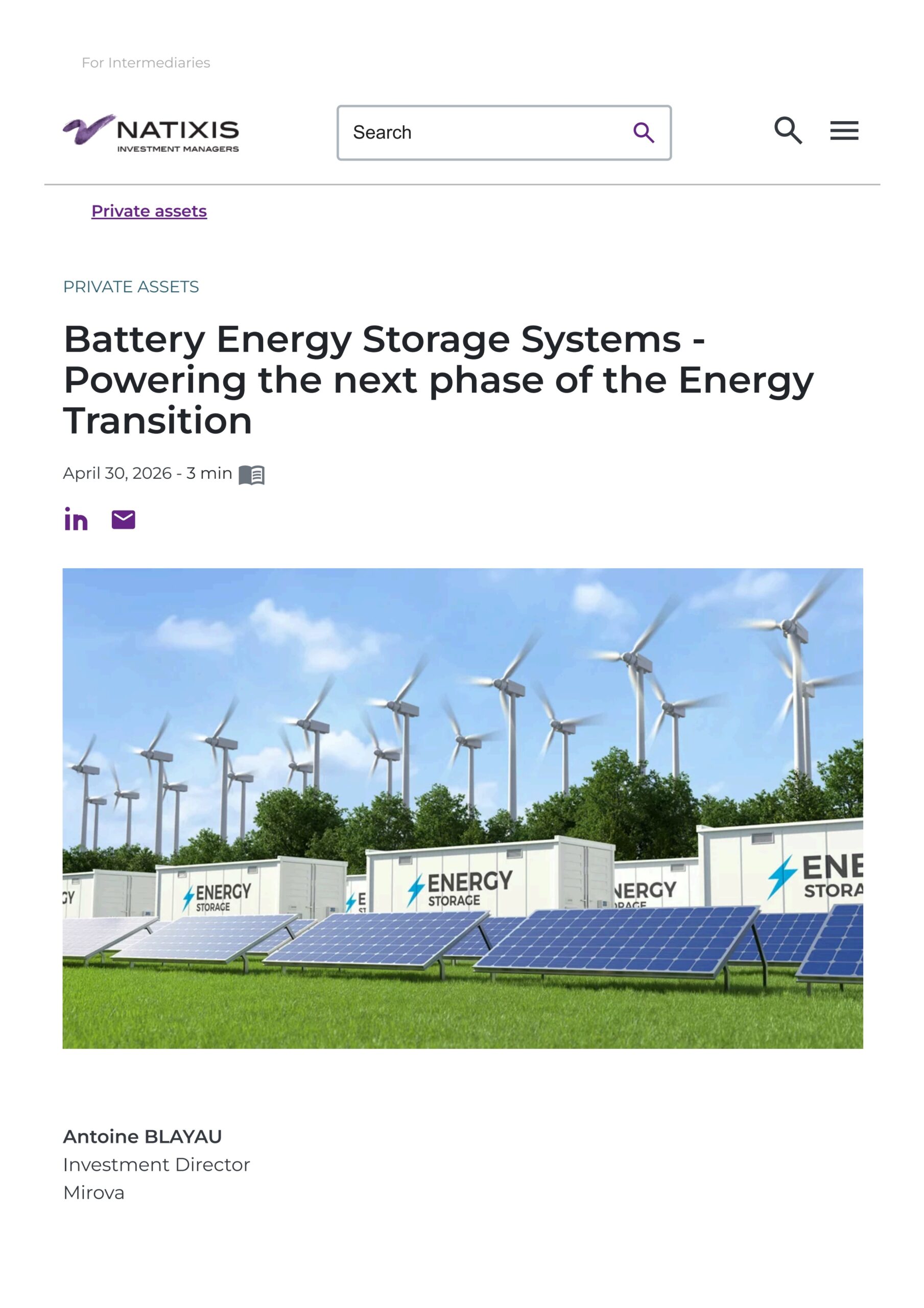
Battery energy storage systems: Powering the next phase of the energy transition
This report explores Battery Energy Storage Systems (BESS) as critical infrastructure for Europe’s energy transition. It highlights BESS’s role in grid stability and optimising renewable integration. Mirova outlines its investment experience, prioritising utility-scale projects that deliver stable returns while supporting European energy sovereignty and ESG principles.
Please login or join for free to read more.

OVERVIEW
Introduction
Battery Energy Storage Systems (BESS) are becoming a cornerstone of Europe’s electricity systems. As power markets evolve to accommodate higher shares of renewable energy and increasing flexibility needs, battery storage supports grid stability, enhances system resilience, and enables the next phase of renewable deployment. Mirova views BESS as critical infrastructure rather than a peripheral asset class. Integrated within wind and solar portfolios, storage helps to unlock the full potential of renewables while contributing to resilient, well-balanced investments for clients.
Flexibility at the core of evolving power markets
The rapid deployment of wind and solar capacity is increasing the share of intermittent generation across European grids. This transformation is driving higher price volatility, more frequent supply-demand imbalances, and a growing reliance on flexibility solutions to match electricity availability with demand. BESS addresses these challenges by strengthening grid reliability, optimising energy value through strategic charging and dispatch, and facilitating renewable integration by mitigating intermittency and reducing curtailment.
Mirova draws on over a decade of experience in BESS investing
Battery storage has been a core component of Mirova’s Energy Transition Infrastructure strategy since its first investment in 2014 with a pioneering solar PV and storage project in France. Through partnerships with specialised players such as Corsica Sole and TagEnergy, Mirova has built in-depth expertise across technical, regulatory, and economic dimensions. Today, the firm develops, owns, and operates storage systems across 10+ countries in Europe, positioning it to capture opportunities created by rapidly evolving power markets.
Selected Mirova examples
Mirova’s approach reflects the diversity of market needs and asset configurations. At Hyperion, their partner in Portugal, BESS is a core enabler of development strategy, systematically integrated with renewable generation assets to strengthen bankability and enhance flexibility. This is illustrated by the hybridisation of an operating PV park and a three-technology project combining wind, solar, and battery storage. In Estonia, the Sunly platform integrates wind, solar, and battery storage within a single operating model to support a sustainable power production profile.
Battery storage supports stable and risk-adjusted infrastructure returns
Mirova views battery storage as a powerful tool to strengthen renewable portfolio resilience. Whether deployed as standalone assets or hybridised, storage improves revenue visibility by enhancing power purchase agreement structuring and reducing exposure to adverse pricing periods. This contributes to stable and predictable cash flows aligned with institutional investor expectations. Investment prioritises capital preservation, long-term stable returns, and contributions to European energy sovereignty.
Investing in storage requires greater agility than traditional wind or solar. Mirova prioritises utility-scale projects capable of revenue stacking. Decisions are guided by two principles: technological safety, emphasizing high fire-safety and thermal-management standards; and monitoring the upstream footprint and critical materials to mitigate environmental and social impacts.
Conclusion
Battery storage is unlocking the next phase of the energy transition and has become a strategic component of infrastructure portfolios focused on renewables. Through early experience, disciplined investment, and integrated ESG practices, Mirova positions storage at the heart of its energy transition infrastructure strategies.