

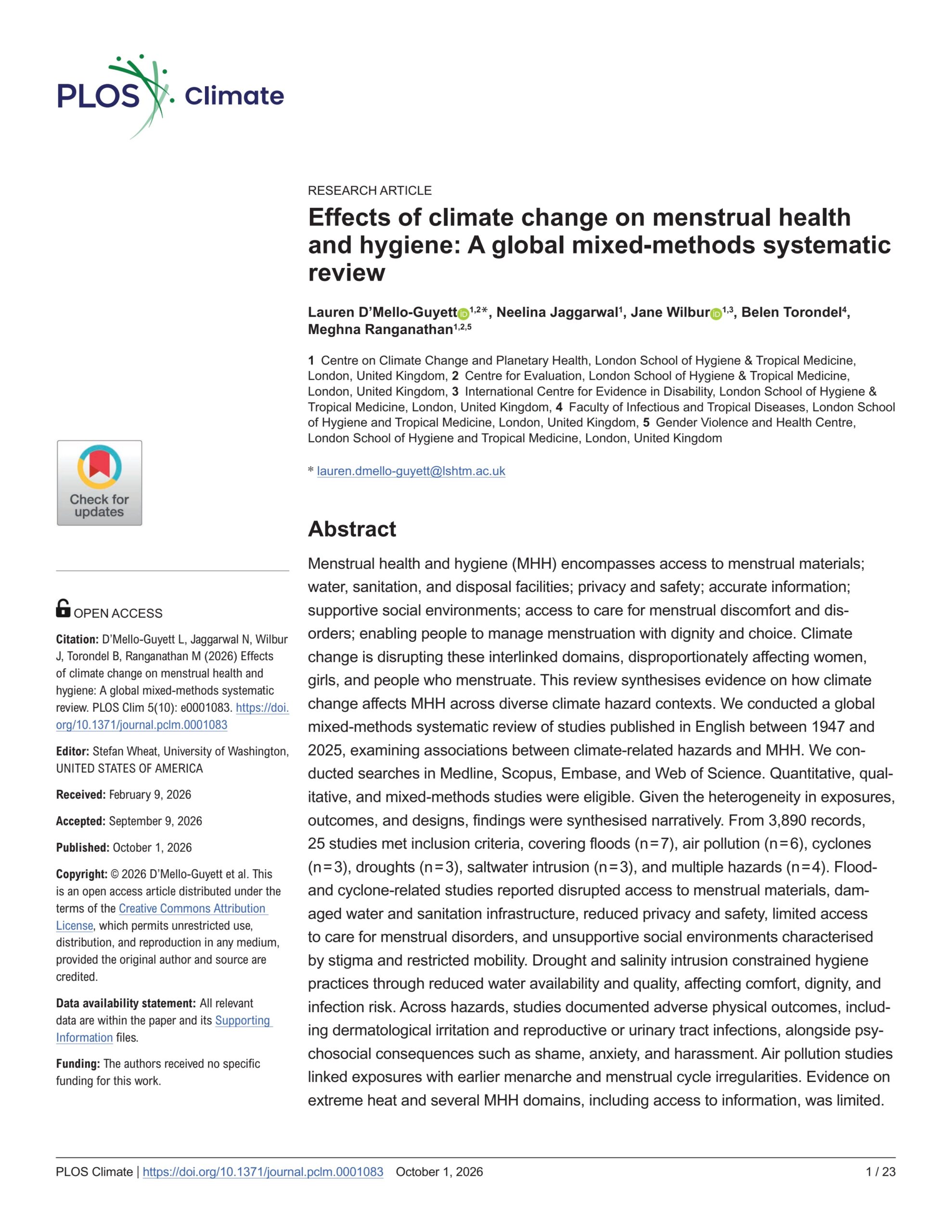
Effects of climate change on menstrual health and hygiene: A global mixed-methods systematic review
This systematic review synthesises evidence on how climate change affects menstrual health and hygiene globally. It finds that floods, cyclones, and droughts disrupt access to materials and sanitation, while air pollution correlates with earlier menarche. The report highlights critical gaps in research regarding extreme heat and equity.
Please login or join for free to read more.

OVERVIEW
Introduction
Climate change refers to long-term shifts in temperature and weather patterns, primarily driven by human activity, which increasingly disrupt human settlements, infrastructure, and ecosystems. These shifts drive more frequent and severe climate-related hazards, associated with rising morbidity and mortality rates. According to the Intergovernmental Panel on Climate Change (IPCC), an estimated 3.6 billion people live in climate-vulnerable contexts, with women, children, and people with disabilities disproportionately affected. Women also comprise an estimated 80% of individuals displaced by climate-related disasters.
Despite its central importance to physical, psychological, and social well-being, menstrual health and hygiene (MHH) remains largely overlooked within climate and health discourse. Menstrual health is a multidimensional construct encompassing access to accurate information, safe menstrual materials, water, sanitation, and hygiene (WASH) facilities, and supportive social environments. Deficits across these domains are associated with negative outcomes, including increased risk of reproductive and urinary tract infections (RTIs and UTIs), reduced school attendance, and limited participation in social life. Globally, more than 500 million women lack adequate facilities for menstrual management.
Methods
This study involved a global mixed-methods systematic review of research published between 1947 and October 2025. The researchers searched databases including Medline, Scopus, Embase, and Web of Science for studies investigating the effects of climate-related hazards or air pollution on MHH. Quantitative, qualitative, and mixed-methods studies were eligible for inclusion. Given the heterogeneity in exposures, outcomes, and designs, the findings were synthesised narratively. Out of 3,890 records identified, 25 studies met the inclusion criteria, covering geographies such as Bangladesh, India, Vanuatu, Pakistan, Poland, the USA, South Korea, Taiwan, and France.
Results
The review identified that climate-related hazards undermine multiple, interconnected domains of MHH. Floods and cyclones were found to disrupt supply chains, leading to acute shortages of menstrual materials and forcing reliance on improvised or unclean absorbents. In Bangladesh, 79% of women lacked sanitation facilities during floods, and 16% struggled to maintain hygiene due to insufficient clean water. In India, women in flood-prone districts reported that MHH was neglected in relief responses, forcing them to travel long distances at night for privacy, exposing them to insecurity and physical danger.
Drought and water scarcity constrained hygiene practices by reducing water availability for washing and bathing. In water-scarce urban communities in India, managing menstruation was tied to “izzat” (personal dignity), with women experiencing embarrassment and humiliation if blood stains were visible. In Bangladesh, indigenous adolescents reported reduced washing frequency and limited water for genital cleaning during seasonal water scarcity. Saltwater intrusion also impacted MHH, as women were forced to use saline water for bathing and washing cloths, resulting in skin itching, rashes, and infections.
Air pollution studies linked environmental exposures with physiological changes. Research from South Korea found that increased exposure to PM10 was significantly associated with an earlier age at menarche. In Taiwan, higher concentrations of nitrogen oxides and carbon monoxide were linked to a significantly higher risk of dysmenorrhea. Notably, no studies were found investigating the effects of extreme heat on MHH, representing a critical gap in the current evidence base.
Discussion
The current evidence base is unevenly distributed across hazards and geographic regions. Flood-related effects dominated the literature in South Asia, primarily through qualitative accounts of disruptions to privacy and dignity. In contrast, air pollution studies were almost exclusively quantitative and concentrated in high-income countries, focusing on biomedical outcomes. Across all hazards, inadequate access to materials emerged as a prominent challenge, often driven by disrupted supply chains and affordability issues. The review also highlighted that gendered power imbalances and restrictive social norms continue to limit agency over menstrual management during climate shocks.
Conclusions
The review concludes that climate change exacerbates existing menstrual health challenges by disrupting access to materials, damaging infrastructure, and undermining supportive environments. There is an urgent need to integrate MHH into climate adaptation, disaster preparedness, and humanitarian response frameworks. Future research should address geographic gaps, particularly in Africa and the Middle East, and focus on under-researched hazards such as extreme heat and slow-onset climate change. Gender- and inclusion-responsive climate policies must explicitly prioritise MHH to ensure the health and dignity of those most affected by climatic shifts.



