

From bonds to blended Finance: How a diverse range of financial instruments are financing climate adaptation and resilience
Analyses 162 cases (2015–2025) of 11 financial instruments financing climate adaptation. Finds blended finance most prevalent, with instruments mainly supporting ex-ante risk reduction. Adaptation finance is largely pooled and increasingly multicountry. Use varies by income level, highlighting growing innovation to mobilise capital for resilience.
Please login or join for free to read more.

OVERVIEW
Highlights
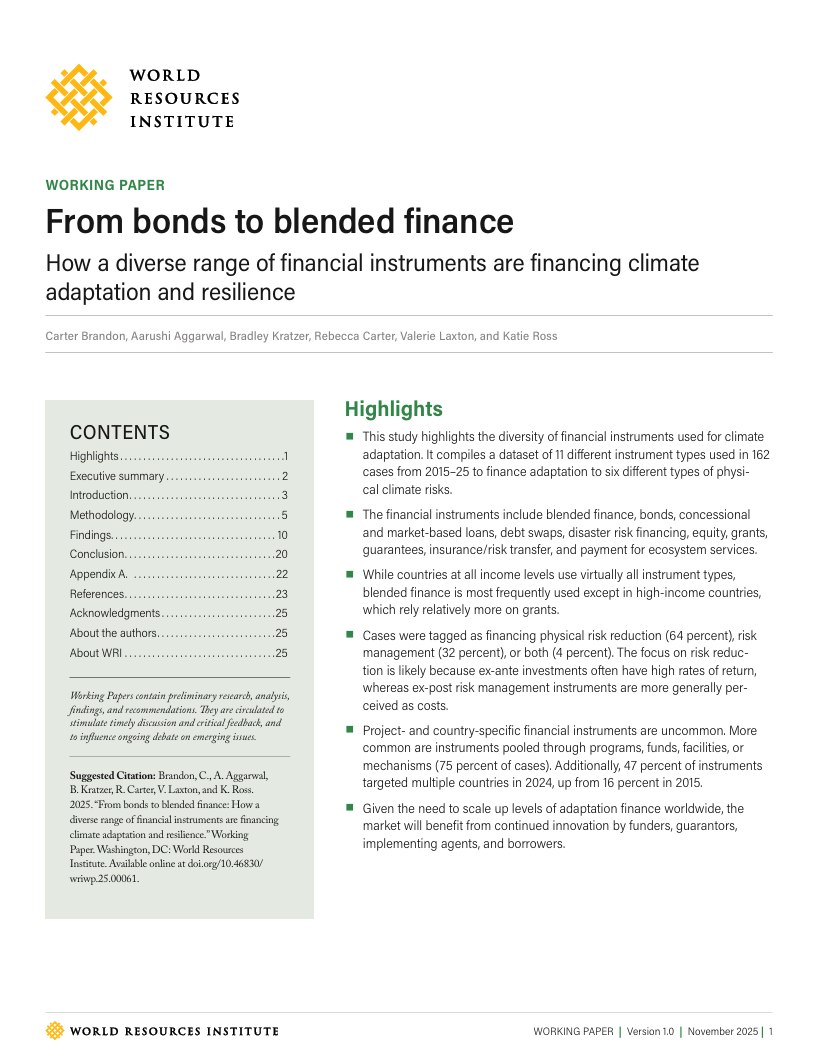
The study analyses 162 cases (2015–2025) across 11 financial instrument types financing adaptation to six physical climate risks. Instruments include blended finance, bonds, concessional and market-based loans, debt swaps, disaster risk financing (DRF), equity, grants, guarantees, insurance/risk transfer, and payment for ecosystem services (PES).
Blended finance is the most frequently used instrument except in high-income countries, which rely more on grants. Sixty-four per cent of cases support risk reduction, 32 per cent risk management, and 4 per cent both. Seventy-five per cent of instruments are pooled, and multicountry approaches increased from 16 per cent in 2015 to 47 per cent in 2024.
Introduction
Adaptation finance remains below estimated needs. International public adaptation finance reached US$27.5 billion in 2022, compared with annual developing country needs of US$188–366 billion through 2030. Adaptation investments show average expected economic internal rates of return of 27 per cent, reflecting avoided losses and wider benefits.
The study responds to calls, including from the G20 Sustainable Finance Working Group, to clarify how financial instruments mobilise capital for resilience. It focuses on droughts, storms, floods, heatwaves, land and ecosystem degradation, wildfires, and broader resilience.
Methodology
The dataset covers 162 instruments launched since 2015, sourced from G20 partners, systematic searches and prior research. It captures instrument type, risks addressed, pooling structure, geography, income level and actor roles. It does not quantify total finance mobilised and underrepresents development bank loans with adaptation co-benefits.
Blended finance (21 per cent), grants (19 per cent) and bonds (17 per cent) are most common. Cases increased steadily after 2019, reaching 26 annually in 2023 and 2024.
Findings
Each financial instrument type addresses a range of physical risks
Multiple instruments address each risk. Bonds, DRF, equity, grants and PES finance all six risks. Over half of cases address multiple risks. Debt swaps concentrate on land and ecosystem degradation (60 per cent of debt swaps). Some specialisation exists; no blended finance cases address wildfires in the sample.
Financial instruments for adaptation focus on risk reduction more than risk management
Risk reduction dominates (64 per cent). Loans, blended finance, bonds and grants mainly support ex-ante resilience. DRF and insurance instruments focus on ex-post response and recovery. Ex-ante investments are likely more prevalent due to higher expected returns, though risk management remains necessary.
Finance for adaptation is mostly pooled through programs
Seventy-five per cent of cases pool finance via programmes, funds, facilities or mechanisms; only 25 per cent are project-specific. Programmes account for 26 per cent of all cases. Funds are often blended finance vehicles, while insurance and reinsurance mechanisms illustrate pooled risk-sharing structures.
Multicountry instruments are increasing in number
Multicountry instruments represent 47 per cent of cases, with 70 per cent of these being blended finance, DRF or insurance/risk transfer. Growth reflects risk pooling, transaction efficiency and scalability, enabling distribution of physical and financial risks across jurisdictions.
Country income status and financial instruments
Low-income countries use most instrument types except debt swaps and equity, with blended finance dominant. Lower-middle-income countries also favour blended finance, followed by bonds. Upper-middle-income countries prominently use blended finance, DRF and sovereign bonds. High-income countries rely mainly on grants and bonds, reflecting stronger creditworthiness and insurance penetration.
Instrument profiles
Blended finance combines concessional and commercial capital from climate funds, development finance institutions and private investors. Bonds are issued by sovereign and subnational governments, MDBs and private entities. Concessional and market-based loans are largely MDB-funded. Debt swaps and DRF involve sovereign governments. Insurance relies on private insurers, often with sovereign backing. PES compensates local actors for ecosystem stewardship.
Conclusion
Adaptation finance relies on diverse and increasingly innovative instruments. Risk reduction predominates due to its economic efficiency. Pooled and multicountry structures are expanding, enabling risk sharing and scalability. Further research is suggested on instrument suitability, scaling debt swaps, private sector roles and guidance for governments selecting adaptation finance options.




