

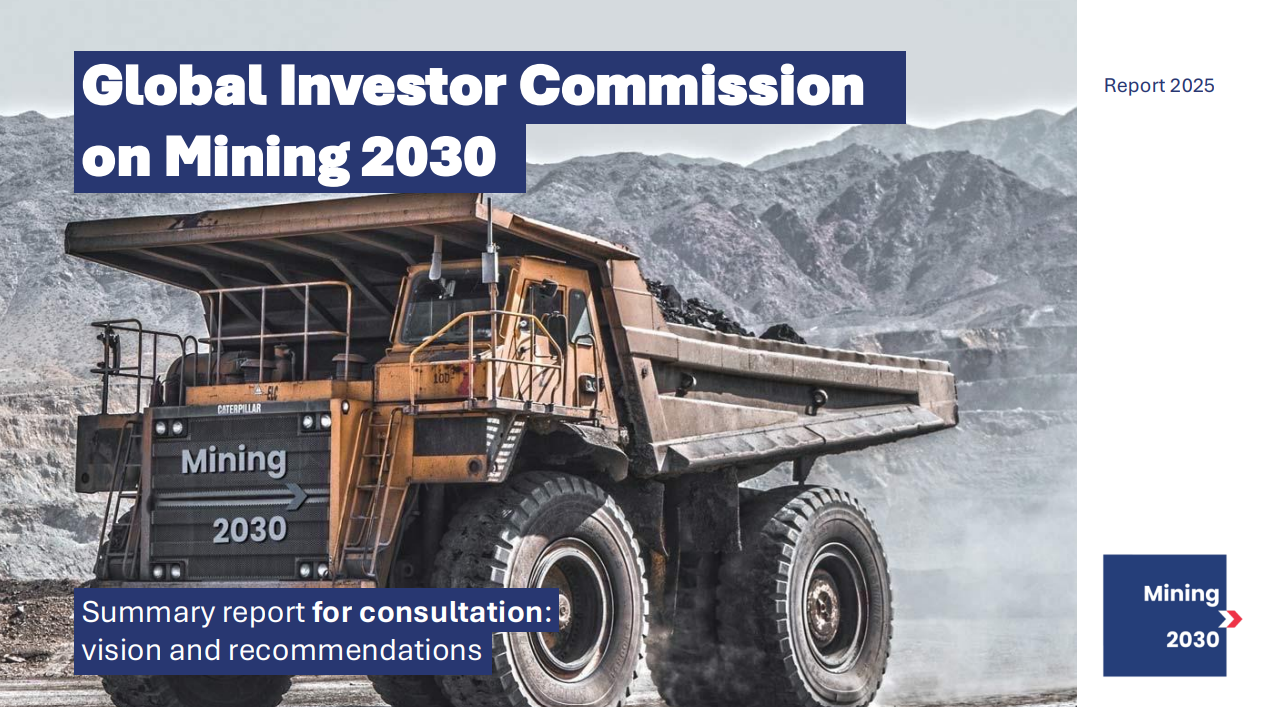
Global investor commission on mining 2030
The report outlines an investor-led 10-year vision for a responsible, resilient mining sector. It sets goals to align capital, governance and stewardship with social and environmental standards, supporting mineral supply for the low-carbon transition while managing risk and long-term value.
Please login or join for free to read more.

OVERVIEW
Context
The report sets out the systemic importance of mining to the global economy and the low-carbon transition. Mining underpins value chains across energy, transport, construction and digital infrastructure, operating in 151 countries. Demand for transition minerals such as lithium, cobalt and copper is projected to triple by 2050 under net-zero scenarios, requiring significant near-term expansion. At the same time, mining faces heightened environmental, social, geopolitical and governance risks, particularly in water-stressed regions, fragile states and Indigenous lands. Poor practices create material financial, legal and reputational risks for investors and can disrupt global supply chains.
The global investor commission on mining 2030
Established in January 2023, the Global Investor Commission on Mining 2030 is an investor-led, multi-stakeholder initiative convened to define a long-term vision for a financially viable, socially and environmentally responsible mining sector. It brings together investors, mining companies, civil society, communities, academics and trade unions. As of October 2025, more than 120 financial institutions representing around USD 18 trillion in assets under management or advice have pledged support. The Commission’s work includes landscape analysis, specialist research, surveys and extensive consultation to clarify how finance can enable responsible mining while safeguarding long-term returns.
Our proposed 10 year vision for the mining industry
The Commission proposes a 10-year vision for a mining industry that can meet global mineral demand while operating to high performance standards, avoiding and minimising harm, and leaving lasting value for communities. Investors recognise mining’s systemic role in portfolios and the energy transition, and the need to manage rising production responsibly. The vision emphasises partnership between investors, industry, regulators and stakeholders, and blends ambition with pragmatism, recognising site-specific and country-specific contexts. Responsible practices are positioned as a means to reduce risk, enhance resilience and support long-term value creation.
The commission’s 2035 goals
By 2035, all operational mines and processing facilities should be assessed against credible, independent performance standards, with zero-harm tailings management and alignment with the Global Industry Standard on Tailings Management. Responsible sourcing should be embedded across mineral value chains to manage risk and build resilience. Governments should be adequately resourced to enforce transparent mining regulation, supported by investor sovereign engagement. The report also sets goals on meaningful stakeholder engagement and equitable benefit sharing, reducing conflicts linked to mineral extraction, and addressing historic legacies through robust mine closure, rehabilitation provisioning and transparency. Suggested actions include harmonised investor expectations, multilateral engagement, improved data and assurance capacity, and the development of common assessment frameworks.
Areas for research and analysis
The Commission identifies priority areas requiring further work, including artisanal and small-scale mining, decommissioning liabilities, assurance capacity constraints, deep-sea mining and circular economy approaches. These issues present material risks and opportunities for long-term investors but require additional evidence, governance development and market mechanisms before they can be fully integrated into responsible investment strategies.
Conclusion and next steps
The report concludes that achieving a responsible, high-performing mining sector is a shared, multi-stakeholder task. Investors have a critical enabling role, but progress depends on coordinated action across governments, industry and civil society. The Commission initiates a public consultation process to refine priorities and implementation pathways before finalising its vision and recommendations.




