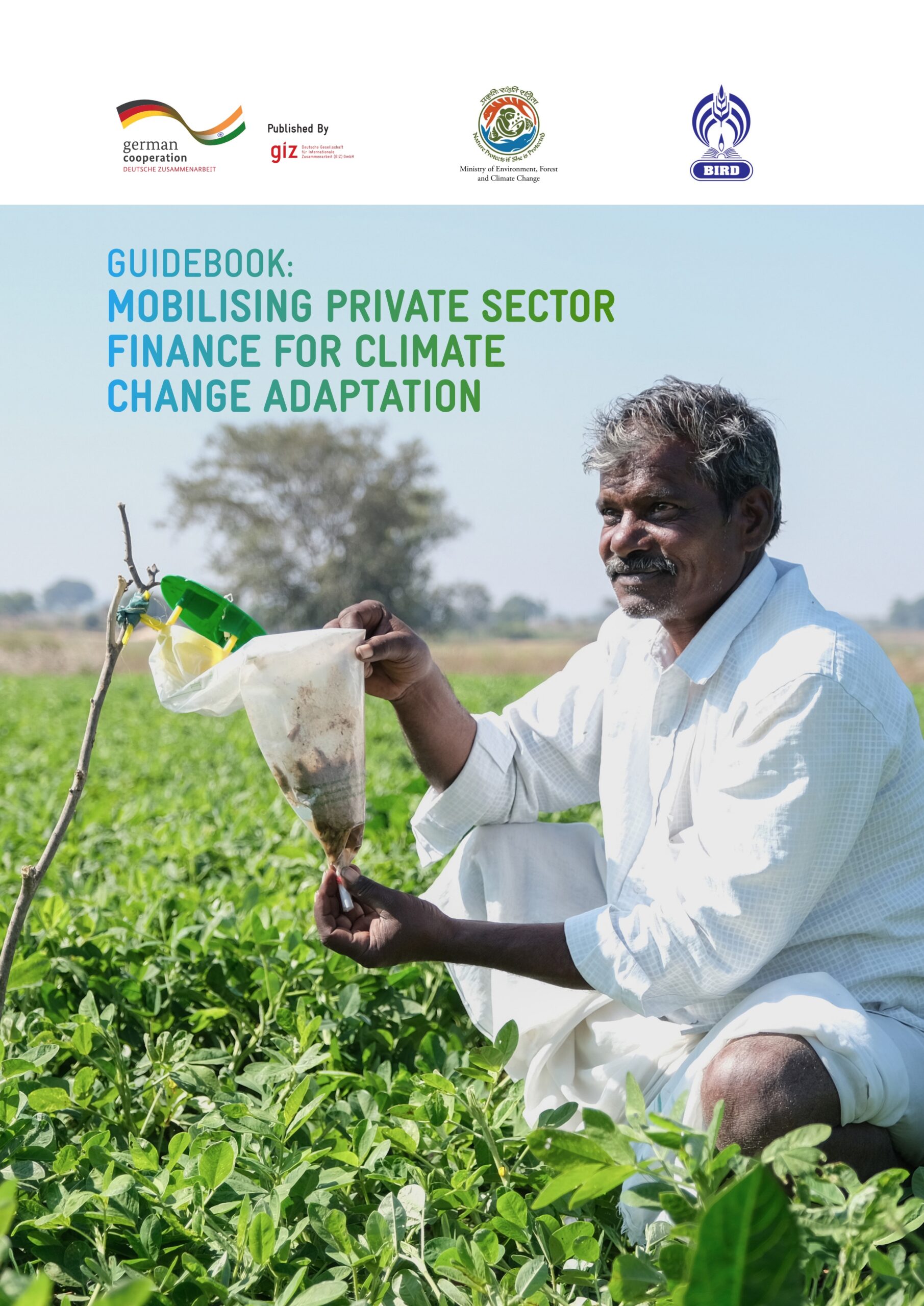
Guidebook: Mobilising private sector finance for climate change adaptation
This guidebook provides a structured framework for designing and financing climate change adaptation projects in India. It addresses barriers to private sector participation, offers methodologies for risk and impact assessment, and explores diverse funding mechanisms, including blended finance, green bonds, and catastrophe insurance, to bridge the significant adaptation funding gap.
Please login or join for free to read more.

OVERVIEW
The Guidebook: Mobilising Private Sector Finance for Climate Change Adaptation is a joint initiative by the Deutsche Gesellschaft für Internationale Zusammenarbeit (GIZ) GmbH and the Bankers Institute of Rural Development (BIRD). It serves as a comprehensive resource for planning adaptation projects in India, specifically targeting the involvement of the private sector to bridge current funding gaps through structured methodologies and innovative financial instruments.
Executive summary
Climate change manifestations, such as shocks (sudden events like cyclones) or stress (slow-onset events like persistent temperature changes), necessitate adaptation interventions. Historically, these have been financed by public sources, but the “Development-Adaptation Continuum” highlights the need for private participation. Challenges to private sector involvement include low project bankability, a lack of standardised appraisal methodologies amongst lenders, and limited access to information for project design. The guidebook provides tools to develop bankable projects and outlines alternate funding models available to the private sector.
Introduction to this guidebook
India requires an estimated USD 1 trillion between 2015 and 2030 to adapt to climate impacts affecting approximately 800 million people. Although the National Adaptation Fund for Climate Change (NAFCC) was established in 2015-16, its 2017-18 budget allocation of INR 1.1 billion (USD 150 million) represented only 0.0057% of India’s GDP. This scarcity of public funds necessitates scaling up contributions from multilateral concessional finance and private sector sources. Public funds should act as a catalyst to draw in private capital to mainstream adaptation initiatives.
Designing a climate change adaptation project
Project development begins with problem identification using the “Problem Tree” technique to map core issues, causes, and effects. This is validated through a climate risk assessment, which defines the system of interest, hazards, exposure, and vulnerability. Vulnerability is further categorised into sensitivity and capacity, including both coping and adaptive capacity. These assessments provide prospective funders with a risk portfolio to suitably price capital.
Impact assessment follows to quantify risks in economic terms. For climate shocks, the Damage and Loss Assessment (DaLA) methodology is recommended, measuring the destruction of physical assets and changes in economic flows. For climate stress, various impact models project environmental and socio-economic trends. Project conceptualisation involves developing a “Solution Tree” and clustering interventions into structural (physical infrastructure) or non-structural (knowledge, policy, training) projects. Feasibility is determined through the Internal Rate of Return (IRR) for structural projects and Social Return on Investment (SROI) or Economic Internal Rate of Return (EIRR) for non-structural ones.
Financing a climate-adaptation project
Identifying potential funding sources is critical. Options include self-financing via crowdfunding or leveraging mitigation finance where adaptation co-benefits exist, such as solar-powered sewing machines. Capital market instruments such as catastrophe bonds, weather derivatives, and green bonds provide mechanisms to transfer risk and raise capital from institutional investors. Public funds like the NAFCC and the National Clean Energy Fund (NCEF) can act as catalysts, while private sector engagement is possible through Corporate Social Responsibility (CSR) and Environmental, Social, and Governance (ESG) investment.
Risk normalisation through blended finance, partial risk sharing facilities (PRSF), and insurance products is essential to attract private investors to “first-of-a-kind” projects. Blended finance mixes public concessional funds with private commercial funds to rebalance the risk-reward profile, while PRSFs can provide sovereign guarantees for minimum offtake or concessions on interest rates.
Project procurement
The implementation stage requires the systematic procurement of goods, works, and services. The guidebook recommends establishing clear procurement guidelines, potentially adopting Government of India standards if financier-specific rules are absent. A dedicated procurement unit should oversee the process, ensuring that selection criteria for structural projects integrate climate-resilient design standards, such as the Green Rating for Integrated Habitat Assessment (GRIHA) or Climate Resiliency Design Guidelines.
Conclusion
Executing adaptation projects requires cross-functional expertise and vertical/horizontal sector coordination. As the regulatory landscape and market conditions evolve, project proponents must stay informed about new financing mechanisms. The guidebook serves as a starting point for developing climate change adaptation projects in India, encouraging users to continually integrate new learning into their project designs.