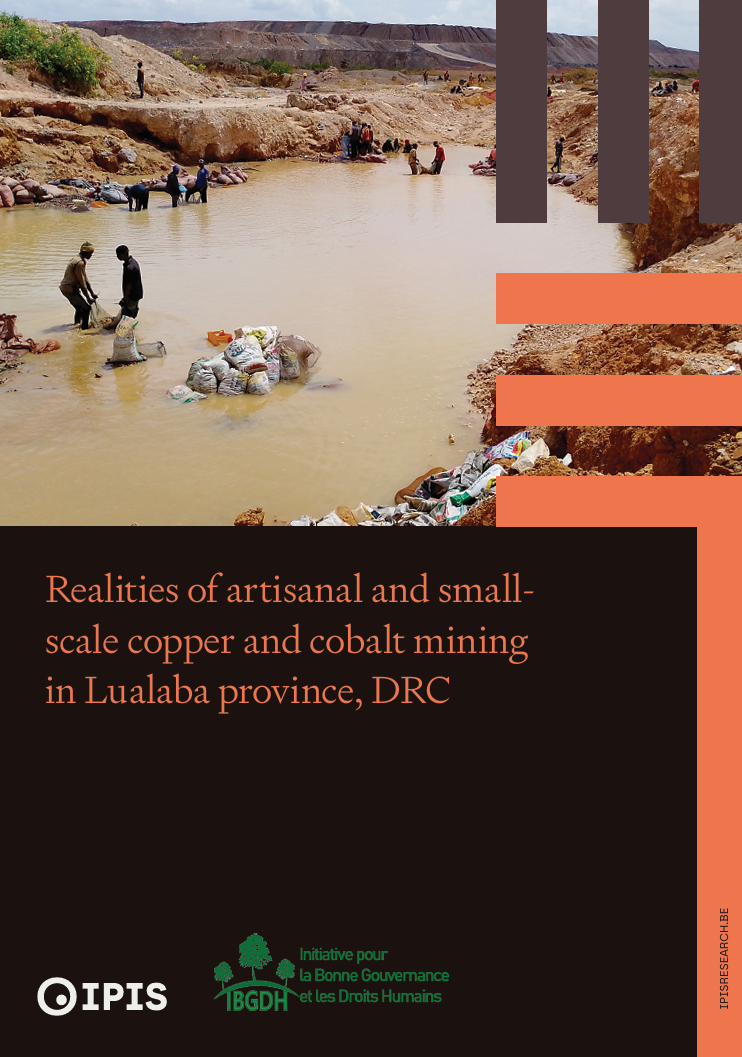
Realities of artisanal and small-scale copper and cobalt mining in Lualaba province, DRC
IPIS and IBGDH mapped 51 artisanal copper and cobalt mines in Lualaba, DRC, employing an estimated 109,000 miners. The study finds few viable designated zones, cooperative elite capture, tension with industrial concessions, unsafe conditions, child labour and extortion by state agents, and recommends creating legal spaces for artisanal miners.
Please login or join for free to read more.

OVERVIEW
Introduction
Copper and cobalt made up 90% of DRC export value in 2023, and copper exports equalled 38% of GDP in 2024. The DRC holds about 50% of world cobalt reserves and produced about 75% of global cobalt in 2024. Artisanal and small-scale mining (ASM) employs an estimated 140,000 to over 400,000 people in Lualaba. Artisanal cobalt was about 15% of Congolese cobalt exports in 2019, and is likely below 10% now.
Methodology
IPIS, with IBGDH and SAEMAPE, visited 51 sites (47 active) around Kolwezi, Mutshatsha and Lubudi in April–May 2025 and interviewed 588 stakeholders.
Artisanal and small-scale production of copper and cobalt
Lualaba had 55 artisanal mining zones (ZEAs) in late 2024, but only two were mined. Only one surveyed mine lay partly within a ZEA; the rest operate as “tolerated” sites on industrial concessions.
The survey estimated 109,107 miners. The four largest sites held 61%. At 32 mines revisited, miner numbers rose from 28,292 in 2019–20 to 59,688, alongside a 42% copper price rise. Semi-industrial operations occurred at about 40% of sites.
Copper was the main mineral at 45 of 47 sites. The cobalt export suspension (February 2025) and later quotas lifted cobalt prices by more than 150%, to about US$56,300 per tonne by January 2026.
Women were 2.6% of miners, with customary rules barring them from 47% of sites. Cooperatives operated at 37 sites and charged 10–30% of production. About half were seen as a burden, though some funded schools and clinics.
Support for cooperatives should build their capacity and inclusive governance, and Article 25 vecies incentives tied to development plans should be explored.
Copper and cobalt trade
Minerals pass through négociants to dépôts (385 in Lualaba; present at 49% of surveyed sites) and then to 11 processing entities. Foreign, mainly Chinese and Lebanese, capital controls much of the trade through local front men. Miners report rigged scales, no independent grading and no payment for cobalt in copper ore. The Musompo trading centre and laboratory is not operational. Channelling pre-financing through Entreprise Générale du Cobalt (EGC) is suggested.
Challenges in artisanal copper and cobalt mining
Limited state oversight and traceability: SAEMAPE and the Mining Division were present at 68% of active sites.
Coexistence with industrial companies: Evictions have caused violence. EGC is pursuing formalisation, including a March 2026 memorandum with Mercuria.
Health and safety: A 2025 collapse at T17 killed 17 and injured 120. Reported accidents in the six months before the visits involved 326 injuries and 33 deaths.
Children: 641 under-18 workers were identified, no more than 0.6% of the workforce.
Unauthorised state services: The military was present at 64% of sites, intelligence services at 53%, and roadblocks at 51%.
Political tensions: Political and military patrons influence cooperatives and traders.
Conclusions and recommendations
About 74% of Congolese live in poverty, yet ASM has delivered little development. Viable ZEAs should be created with SAEMAPE, the governor, the Mining Division, CAMI and SGN-C, and ARECOMS measures examined for collaboration with concession holders. Technical fixes alone will not suffice; conflicts of interest among elites must also be addressed.