

The Box: syndication fee league tables
This benchmark series provides transparency on bank syndication fees, comparing income from sustainable and unsustainable activities. It tracks league tables for global and regional financial institutions, including the ASEAN and Japanese markets. The analysis enables investors to incentivise behavioural change by identifying banks that continue to prioritise fossil fuel financing.
Please login or join for free to read more.

OVERVIEW
Overview
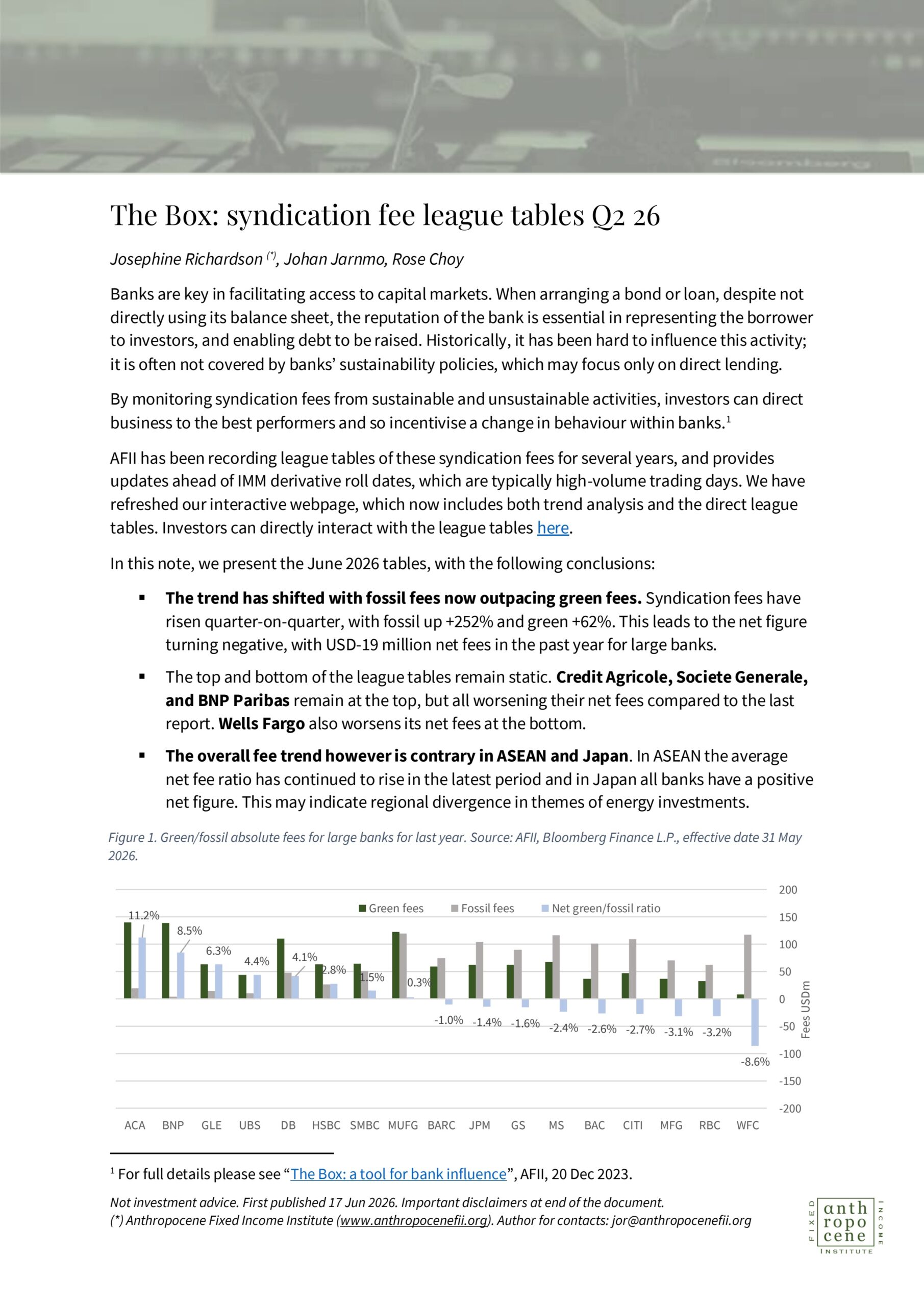
The Anthropocene Fixed Income Institute (AFII) produces “The Box: syndication fee league tables”, a benchmark series that monitors bank syndication fees generated from green and fossil-fuel-related activities. This specific report presents the June 2026 data, covering large and intermediate global banks, with focused regional analyses for the ASEAN and Japanese markets. By recording these fees over several years, the series provides a data-driven view of how capital market facilitators are aligning with global sustainability goals. The document includes detailed league tables and trend analyses to illustrate the current landscape of bank-led financing across multiple jurisdictions.
Purpose
The primary purpose of this benchmark series is to provide transparency into a segment of banking activity—syndication—that is often excluded from traditional sustainability policies, which frequently focus only on direct lending. Because banks facilitate access to capital markets without necessarily using their own balance sheets, their reputation is essential in representing borrowers to investors. This series aims to monitor these activities so that investors can direct their business towards the best performers and so incentivise a change in behaviour within banks. By highlighting the ratio of green to fossil-fuel fees, the report seeks to encourage financial institutions to prioritise sustainable finance over fossil fuel expansion.
Methodology
The analysis utilises data from Bloomberg Finance L.P. alongside the AFII’s own proprietary tracking. The methodology involves collecting data at the deal level for vanilla securities, including bonds and loans, while excluding complex instruments such as variable interest redemptions and convertibles. Fees are allocated based on a bank’s contribution to a deal, with lead arrangers receiving a higher weighting. For deals where fee information is not publicly available, the AFII employs Bloomberg’s Bond Fee Model to estimate figures. The rankings are based on a net green/fossil metric, calculated as total green fees minus total fossil fees, divided by total fees. This percentage allows for comparisons between banks of different sizes. Data is collected over a one-year rolling window to understand changes in behaviour, with three years of data used to calculate two years of rolling fees.
Use for finance professionals
Finance professionals, including asset owners and investment managers, can use these league tables to assess the climate alignment of their banking counterparties. The report proposes an implementation procedure for “The Box”, suggesting that investors can communicate with bottom-ranked banks regarding the risk of exclusion from future fee-generating activities. For example, asset managers might de-list poor-performing institutions from eligible counterparty lists for products such as cash bonds, credit derivatives, and foreign exchange transactions. Conversely, bond issuers can use the data to select lead managers for their own green bond issuances, ensuring their financial partners’ activities are consistent with their own sustainability objectives. The frequency of the updates allows for these feedback loops to be integrated into standard quarterly compensation and review cycles.




