

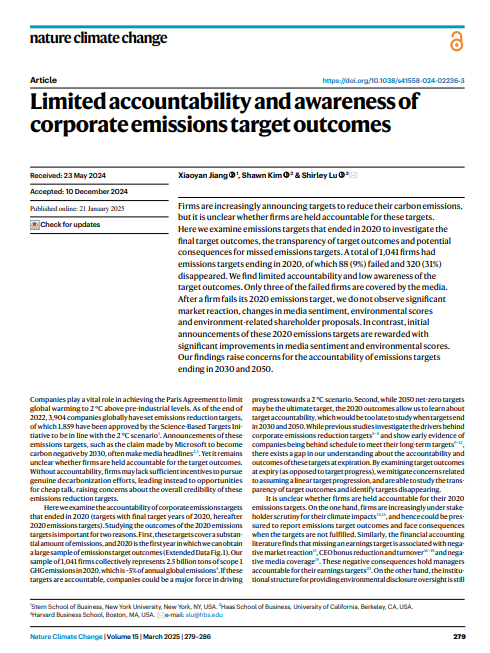
Limited accountability and awareness of corporate emissions target outcomes
The study analyses 1,041 corporate emissions targets ending in 2020, finding limited accountability. Thirty-one per cent of targets disappeared and 9% failed, with minimal disclosure, media attention or market penalties. By contrast, target announcements improved media sentiment and ESG scores, raising concerns for future climate targets.
Please login or join for free to read more.

OVERVIEW
Introduction
The study assesses whether firms are held accountable for corporate emissions reduction targets by analysing outcomes of targets ending in 2020. Although climate targets are increasingly announced and publicly recognised, the paper questions their credibility by examining target achievement, transparency, media awareness and stakeholder responses, with implications for longer-term targets ending in 2030 and 2050.
2020 Emissions target outcomes
Using CDP data, the study analyses 1,041 firms with emissions targets ending in 2020, representing around 2.5 billion tonnes of scope 1 emissions, or roughly 5% of global annual emissions. Of these firms, 60.8% achieved their targets, 8.5% failed, and 30.7% disappeared by ceasing disclosure before 2021. Disappeared firms are not primarily explained by COVID-19 disruptions, and 63.2% of those with absolute targets would likely have failed. Failure and disappearance are more common in high-emissions sectors, while achievement rates are higher in common-law countries and jurisdictions with greater press freedom. Target ambition is not associated with failure.
Transparency of target outcomes
Transparency around emissions target outcomes is weak. Only 12 firms issued press releases on target outcomes, all relating to achieved targets. Among failed firms, just one-third acknowledged failure in sustainability reports, and only one-fifth did so explicitly. Media coverage is minimal: only three failed firms received any coverage, all following firm disclosure, and no disappeared targets were covered. Overall, both corporate disclosure and independent media scrutiny of target outcomes are limited.
Consequences of failed targets
The study finds no meaningful consequences for firms that fail emissions targets. There is no significant market reaction, change in trading volumes, deterioration in media sentiment, increase in environmental shareholder proposals, or decline in environmental scores from major ESG rating providers. These results persist after accounting for alternative explanations such as prior information on target progress, COVID-19 impacts, target ambition and emissions materiality, indicating a general absence of penalties for non-achievement.
Contrasting to the announcement of targets
In contrast, announcements of emissions targets generate clear benefits. Target announcements attract substantially more media attention than target outcomes and are followed by statistically significant improvements in long-term media sentiment and environmental scores from ESG rating agencies. However, no significant market valuation effects are observed. This asymmetry suggests firms can gain reputational benefits from announcing targets without facing accountability for delivery.
Discussion
Overall, the study concludes that corporate emissions targets ending in 2020 exhibit limited accountability, weak transparency and low stakeholder awareness. Many targets disappear without explanation, failures are rarely disclosed or reported, and firms face few consequences for non-achievement, while announcements are rewarded. The findings raise concerns about the credibility of future climate targets and highlight the importance of stronger disclosure requirements, monitoring institutions and information dissemination to improve accountability.




