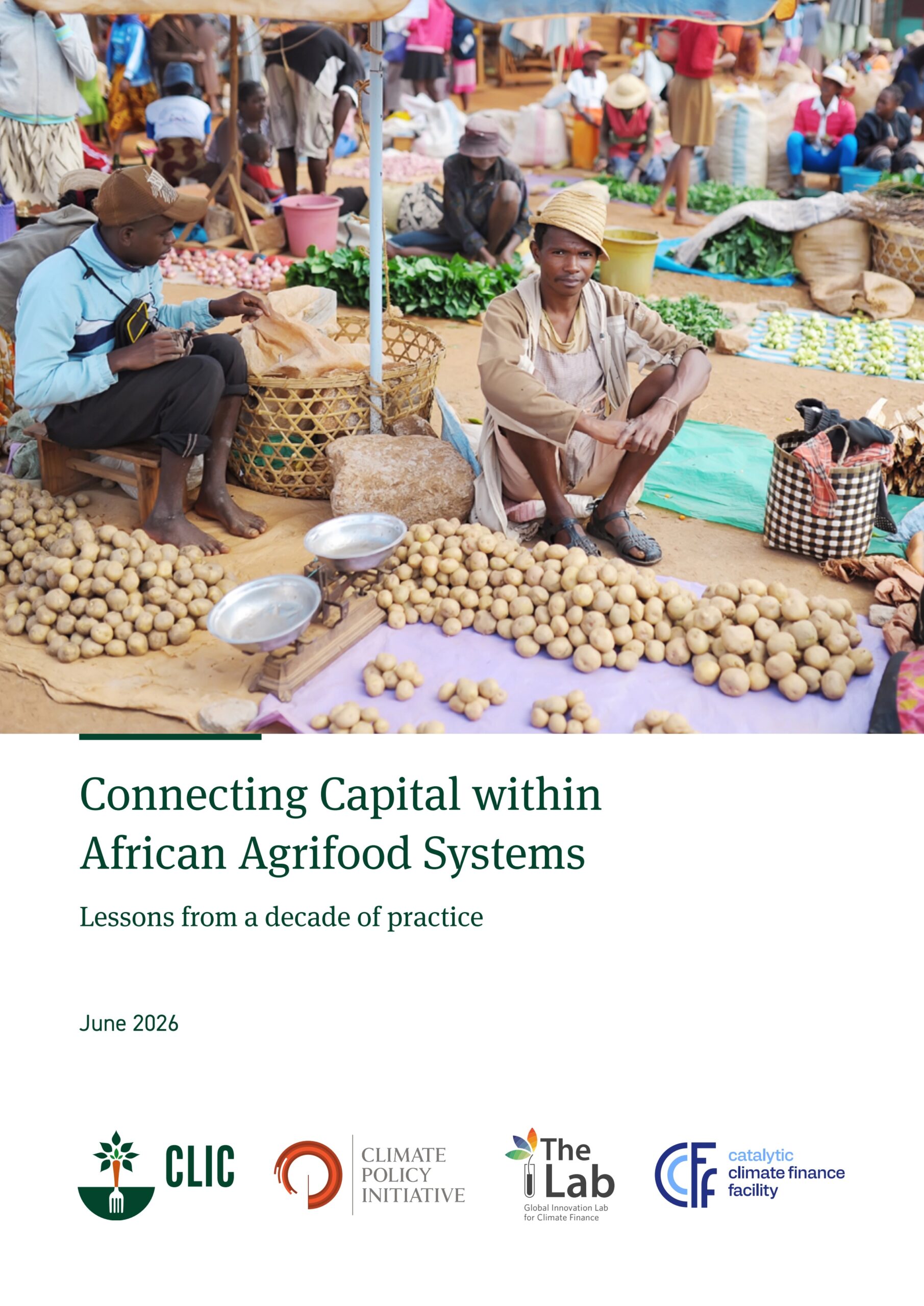
Connecting capital within African agrifood systems: Lessons from a decade of practice
This report examines the structural misalignment between investors and agribusinesses in African agrifood systems. It highlights that while annual climate finance reached USD 7.8 billion, it falls short of the USD 1.1 trillion global requirement. Recommendations focus on improving technical assistance and intermediation to mobilise capital effectively.
Please login or join for free to read more.

OVERVIEW
Introduction
Climate finance for African agrifood systems is growing but remains a fraction of the total requirement. Between 2019/20 and 2021/22, annual climate finance to these systems increased from USD 4.4 billion to USD 7.8 billion, yet this remains far below the annual global financing need of USD 1.1 trillion. Agriculture employs 65% of the sub-Saharan African workforce and produces up to 70% of the region’s food, yet these systems are chronically underfinanced. The financing gap persists due to a structural misalignment between the mandates of capital providers and the operational realities of agribusinesses.
CPI’s programmes and portfolio
Climate Policy Initiative (CPI) addresses market failures through three distinct technical assistance (TA) programmes. The Global Innovation Lab for Climate Finance (the Lab) has supported 10 active finance vehicles in African agrifood systems, mobilising over USD 5 billion globally since 2014. The Catalytic Climate Finance Facility (CC Facility) provides grants of up to USD 500,000 and has supported seven active African vehicles, mobilising USD 188 million since 2023. The Agrifood Investment Connector (the Connector) has supported 23 climate-positive agribusinesses in sub-Saharan Africa, raising USD 18.7 million in finance. Portfolio activity is concentrated in established markets, with Kenya, Nigeria, and Uganda accounting for nearly half of all engagements, while the ten most vulnerable African countries receive only 11% of climate finance flows.
Lessons from working across the ecosystem
Evidence from CPI’s portfolio highlights that effective vehicle design must start with strong demand-side intelligence to calibrate mandates with market realities like ticket sizes and absorption capacities. Geographic and thematic proximity alone are insufficient for investment; active intermediation is required to align timing, mandates, and enterprise readiness. Furthermore, enterprise preparation is most effective when linked to specific investor requirements rather than generic benchmarks. A significant finding is that most commercial capital currently favours export-oriented cash crops like coffee and cacao, leaving a shortfall in financial structures purpose-built for local food crop economies, which are critical for food security.
Recommendations for donors and TA providers
The report suggests that supply-side TA providers should require vehicle proponents to demonstrate specific pipeline knowledge in harder-to-reach segments. Bilateral donors and foundations should fund coordination infrastructure and pre-investment enterprise TA as dedicated structures to bridge the gap between traditional donor-driven support and investor requirements. Development Finance Institutions (DFIs) and multilateral climate funds are encouraged to back blended funds that combine cash and food crop investments. Additionally, programmes should track failure points systematically and complement broad sector convenings with mandate-specific matching to ensure high-probability introductions.
Conclusion
While many building blocks for a well-functioning agrifood climate finance ecosystem are present in Africa, the central challenge remains how these components connect in practice. Future TA programming must place a greater emphasis on conversion by ensuring efforts are designed to translate activity into investment. Prioritising alignment across actors and directing resources toward segments where structural gaps persist, such as food crop economies, will be essential to achieving climate, nature, and food security outcomes.