WWF Risk Filter Suite
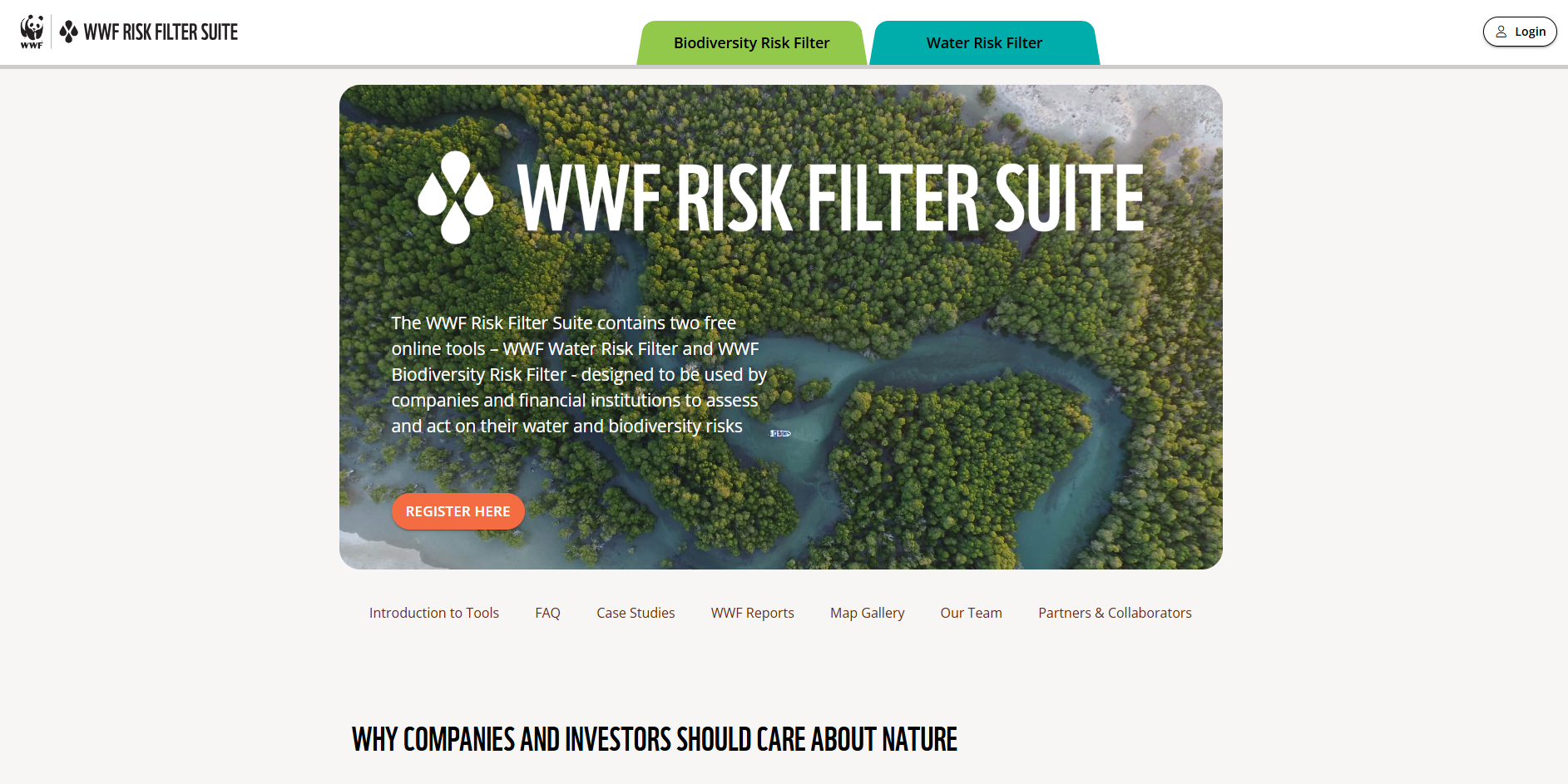
A free online screening suite from WWF featuring Water and Biodiversity Risk Filters. It helps financial institutions and companies identify nature-related physical and regulatory risks across portfolios using 80+ global datasets.
Please login or join for free to read more.

OVERVIEW
The WWF Risk Filter Suite is a free online platform comprising two distinct tools: the WWF Water Risk Filter and the WWF Biodiversity Risk Filter. It is designed to assist companies and financial institutions in assessing and managing nature-related risks within their operations and supply chains. By aggregating over 80 global scientific datasets, the suite translates complex environmental data into business-relevant indicators to support strategic decision-making and sustainable investment.
Organisation behind the tool
The tool was developed and is maintained by WWF (World Wide Fund for Nature). The suite incorporates data from various global scientific sources and is aligned with frameworks such as the Taskforce on Nature-related Financial Disclosures (TNFD) and Science Based Targets for Nature (SBTN).
What the tool does
- Provides screening and prioritisation of risk hotspots across global investment portfolios and value chains.
- Assesses physical, regulatory, and reputational risks related specifically to water and biodiversity.
- Features a Portfolio Manager for users to upload and manage location-specific data securely.
- Includes interactive maps, country profiles, and industry-specific materiality ratings.
- Offers “Inform”, “Explore”, “Assess”, and “Act” modules to guide users from initial understanding to implementation of risk-reduction measures.
Target audience
The primary users are medium to large-scale companies and financial institutions with complex supply chains or diverse investment portfolios. It is also utilised by researchers and policymakers focused on environmental risk management.
Relevance to finance professionals
- Risk assessment – Identification of physical and reputational risks across thousands of assets to inform due diligence and risk mitigation.
- ESG analysis – Alignment with international reporting standards including TNFD, TCFD, GRI, and ESRS.
- Market/commodity insights – Understanding nature dependencies in specific sectors such as agriculture, forestry, and infrastructure.
- Investment context – Practical application of the TNFD LEAP approach and SBTN target-setting through dedicated technical guides.