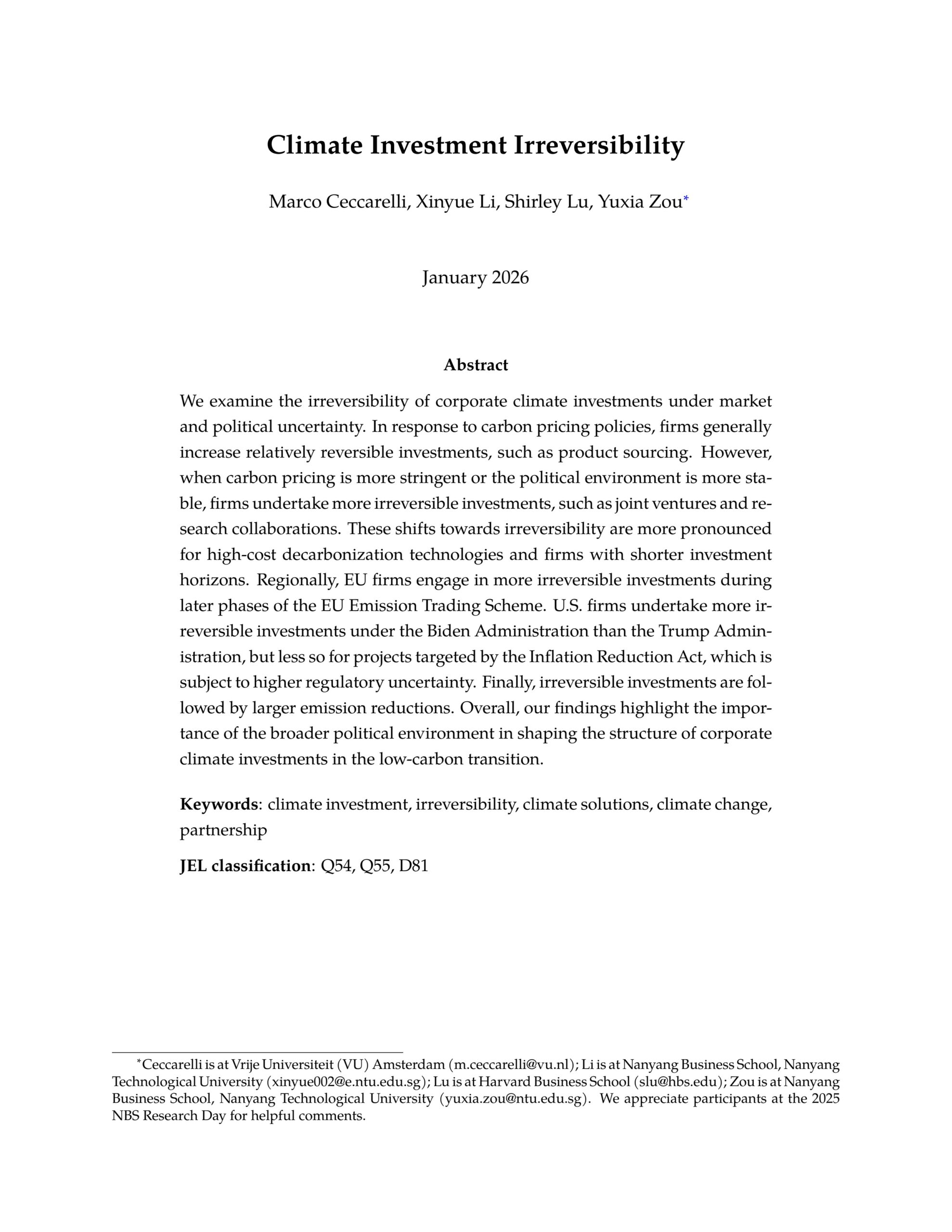
Climate investment irreversibility
This research examines corporate climate investment irreversibility under market and political uncertainty. It finds that while carbon pricing encourages reversible investments, political stability is essential for inducing irreversible commitments like joint ventures. Irreversible investments lead to significantly larger emission reductions, highlighting the importance of stable policy frameworks for decarbonisation.
Please login or join for free to read more.

OVERVIEW
Introduction
The transition to a low-carbon economy necessitates substantial corporate investment, often characterised by high capital intensity and exposure to significant market, political, and technological uncertainty. While existing research suggests that policy uncertainty can delay or discourage investment, this paper explores an understudied dimension: the irreversibility of climate investments. Reversible investments, such as supply contracts, allow for flexibility, whereas irreversible investments, such as joint ventures or research collaborations, involve long-term commitments that are costly to unwind. The study conceptualises irreversibility as a strategic choice rather than an exogenous characteristic, hypothesising that carbon pricing primarily encourages reversible investments unless accompanied by a stable political environment.
Literature review and conceptual underpinnings
Economic theory suggests that investment irreversibility creates an ‘option value of waiting’ under uncertainty. In the climate domain, where solutions like offshore wind or carbon capture require high upfront costs, irreversible investments are vital for progress. However, clean technology investments face a ‘double externality’ problem: environmental externalities from emissions and innovation externalities that lead to underinvestment. Addressing these requires stable policy frameworks. Prior research indicates that firms scale back decarbonisation projects when policy uncertainty is high. This paper extends this by viewing irreversibility as a strategic response to the level of policy certainty, such as when a firm chooses between a simple supplier contract or a joint venture for battery sourcing.
Data and sample
The empirical analysis primarily utilises global firm-to-firm business relationship data from FactSet Revere, covering contracting types such as suppliers, joint ventures, and research collaborations. Carbon pricing data is sourced from the World Bank Carbon Pricing Dashboard, and political stability is measured using the World Bank Worldwide Governance Indicators. The final sample consists of 212,630 source firm-year observations. Decarbonisation contracts are identified using a lexicon approach based on a climate solutions dictionary and a fine-tuned GPT classifier. Contracts are mapped to 88 climate solution categories defined by Project Drawdown.
Climate investment irreversibility measurement and descriptive statistics
The study finds that reversible decarbonisation investments are twice as common as irreversible ones, though both are increasing over time. While 22% of all contracts are classified as irreversible, 27% of decarbonisation-related contracts fall into this category. This trend is more pronounced in research and development, where 21% of decarbonisation investments are irreversible compared to 7% in the general sample. Geographically, irreversible investments are more concentrated in Europe (26% compared to 17% of overall contracts). Across sectors, construction firms show the highest tendency for irreversible contracts (44%), while agriculture, forestry, and fishing firms have the lowest (20%). Spain leads in decarbonisation contract prevalence at 23% of firms, and Danish firms exhibit the highest investment intensity at 1.5 contracts per year.
Climate investment irreversibility and political stability
Exposure to carbon pricing is associated with a 4.5% higher probability of a firm having decarbonisation-related business relationships. However, carbon pricing alone induces more reversible commitments (4.2%) than irreversible ones (2.3%). The stringency of the policy matters; firms in high-carbon-price regimes are three times more likely to engage in irreversible relationships than those in low-price regimes. Crucially, political stability acts as a catalyst. In countries with high political stability, the positive effect of carbon pricing on irreversible contracts is nearly three times larger. Cross-sectional analysis shows this interaction is stronger for high-cost technologies, such as offshore wind and geothermal energy, where the magnitude (0.018) is twice that of low-cost technologies (0.008).
Regional variations in regulatory environment
In the United States, climate investment patterns tracked presidential cycles. The Biden administration is associated with a significant uptick in the quantity of irreversible climate contracts, with a coefficient of 0.068. Conversely, projects targeted by the Inflation Reduction Act (IRA), such as clean hydrogen, saw an increase in reversible projects relative to irreversible ones, likely due to higher regulatory uncertainty and potential for policy reversal. In the European Union, the increasing stringency and stability of the EU Emissions Trading Scheme (ETS) from Phase 2 to Phase 4 coincided with a progressive rise in both reversible and irreversible investments, particularly in the later, more stable phases.
Validation with emissions intensity
Direct validation of the measure reveals that emissions intensity declines following both types of decarbonisation investment. However, a firm’s first irreversible investment is followed by a larger reduction in emissions intensity (approximately 1.8%) compared to a firm’s first reversible investment (about 1.0%). When both investment types are included in a joint model, only the coefficient for irreversible investment remains statistically significant, corresponding to a 1.6% reduction. This suggests that irreversible investments represent deeper, more effective commitments to the low-carbon transition.
Conclusion
The paper concludes that the structure of corporate climate investments is heavily influenced by the broader political and regulatory environment. While carbon pricing encourages participation in the transition, stable policy frameworks are essential to shift the composition of these investments toward long-term, irreversible commitments. These deeper commitments are not only more effective at reducing emissions intensity but also generate positive externalities, such as supply chain coordination and innovation spillovers. Consequently, regulatory credibility is central to reducing the option value of waiting and ensuring the resilience of the global climate transition.