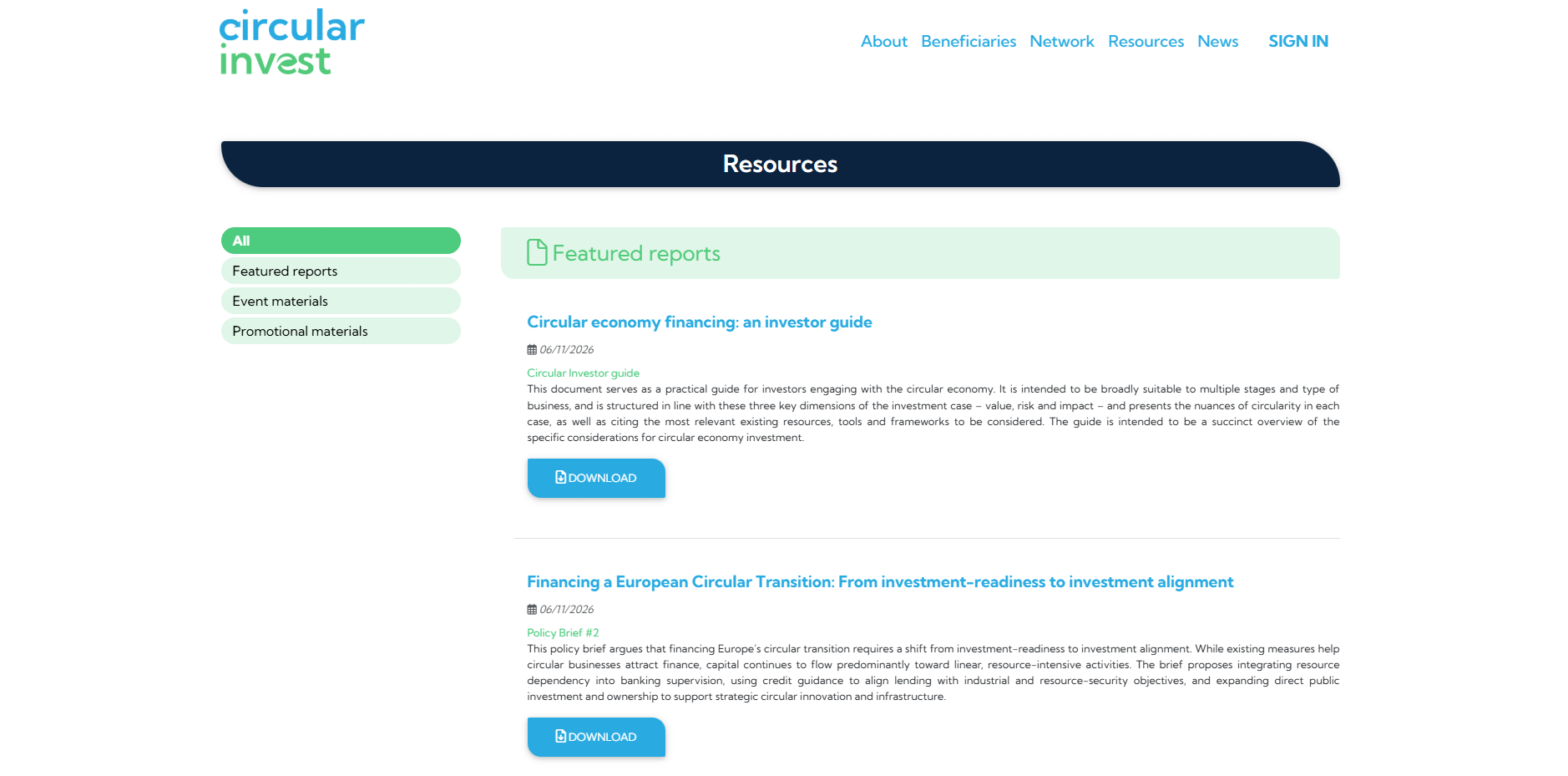
CircularInvest guiding documents for investors and start-ups
CircularInvest provides guidance and resources to help circular economy projects become investment-ready. It supports investors and start-ups by bridging the gap between innovative circular systemic solutions and private finance within the European Union.
Please login or join for free to read more.

OVERVIEW
CircularInvest provides a suite of resources designed to bridge the gap between circular economy projects and private finance. As an initiative under the EU Circular Cities and Regions Initiative (CCRI), it aims to accelerate the implementation of circular systemic solutions across European regions by making local projects more attractive to investors. For finance professionals, these resources offer a framework for evaluating circularity as a core component of investment readiness.
Organisation behind the tool
CircularInvest is an initiative of the Circular Cities and Regions Initiative (CCRI), funded by the European Union and supported by the European Research Executive Agency. It is implemented through a multi-stakeholder collaboration designed to assist project owners in developing bankable circular economy business models.
What the tool does
The platform provides guiding documents and resources that assist users in navigating the circular investment landscape. Key features include:
- Frameworks for assessing the investment readiness of circular projects.
- Guidance for start-ups on structuring business cases for circularity.
- Access to a network of beneficiaries and stakeholders within the European circular economy ecosystem.
- Methodological support for implementing circular systemic solutions at a city or regional scale.
Target audience
The primary users include private and institutional investors, circular economy start-ups, project developers, and local or regional policy makers seeking to facilitate green investment.
Relevance to finance professionals
Finance professionals can use these resources to enhance their approach to sustainable finance in several ways:
- Risk assessment – Understanding the specific operational and market risks associated with circular business models compared to linear ones.
- ESG analysis – Implementing standardised circularity metrics into environmental reporting and due diligence processes.
- Market/commodity insights – Identifying emerging opportunities in resource recovery, waste-to-value, and regenerative infrastructure.
- Investment context – Aligning portfolios with EU circular economy policy objectives and the broader transition toward a resource-efficient economy.