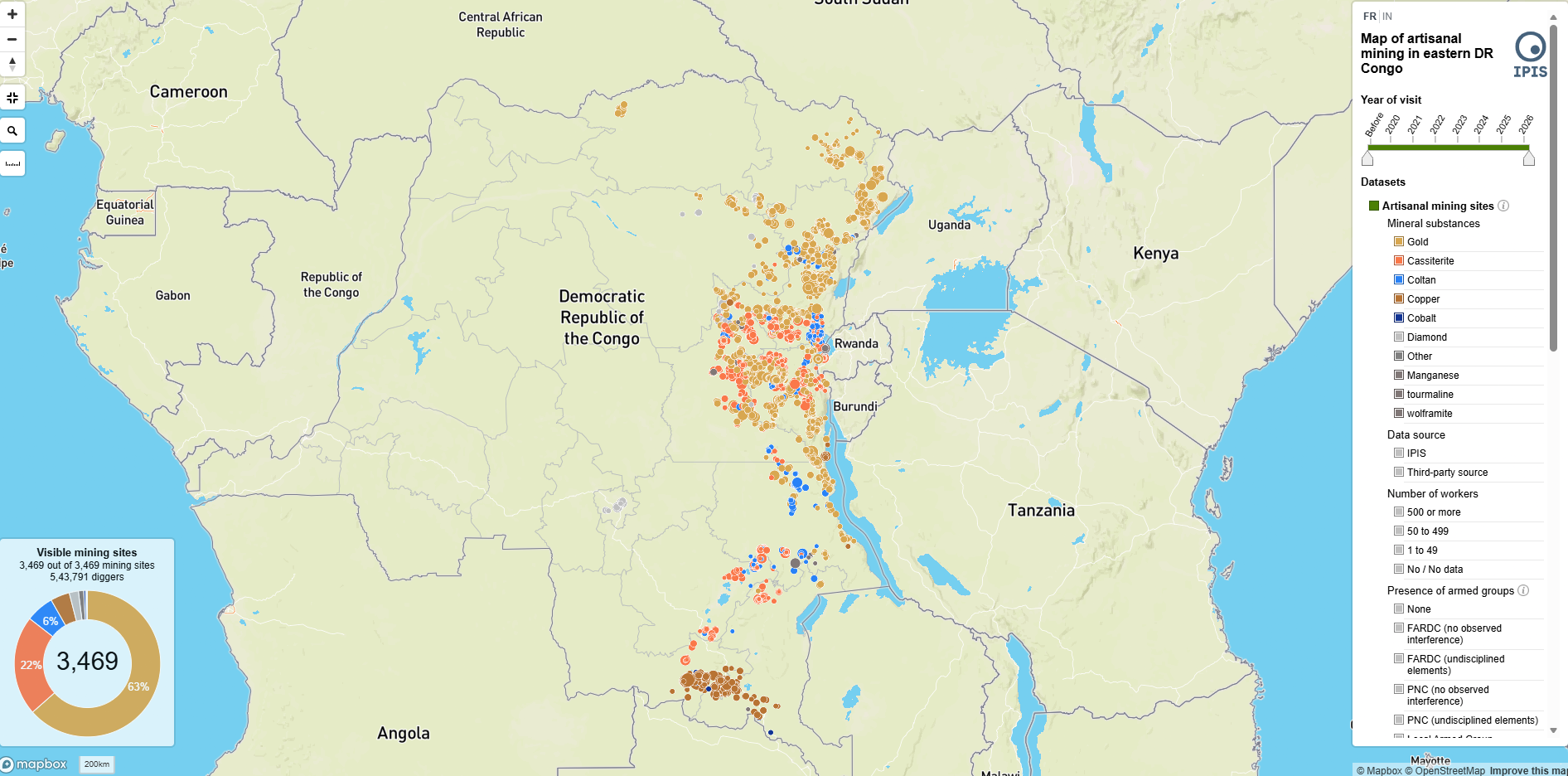
IPIS webmap of artisanal mining sites in the DRC
The IPIS webmap provides detailed geospatial data on artisanal mining sites in the Democratic Republic of the Congo. It tracks mineral production, the presence of armed groups, and socio-economic conditions to support supply chain due diligence and ESG risk assessment.
Please login or join for free to read more.

OVERVIEW
The IPIS webmap of artisanal mining sites in the Democratic Republic of the Congo (DRC) is a specialised geospatial database and interactive tool. It provides detailed data on the location, status, and socio-economic context of over 2,000 artisanal mining sites across the eastern DRC. For finance professionals, this tool is significant for assessing supply chain integrity, human rights risks, and the presence of armed groups in mineral sourcing regions.
Organisation behind the tool
The tool is developed and maintained by the International Peace Information Service (IPIS), an independent research institute based in Belgium. The mapping project is frequently supported by partnerships with organisations such as the Congolese Ministry of Mines and various international development agencies.
What the tool does
The interactive platform allows users to filter and visualise a wide range of data points related to artisanal mining, including:
- Geographic locations of mining sites and their primary mineral output (e.g. gold, tin, tantalum, tungsten).
- The presence and influence of armed groups or the Congolese national army (FARDC) at specific locations.
- The legal status of mining sites and their compliance with international due diligence standards.
- Information on labour conditions, including the presence of child labour and health and safety risks.
- Trade routes and the location of mineral processing and trading centres.
Target audience
The primary audience includes supply chain managers, ESG analysts, international policymakers, and non-governmental organisations focused on conflict minerals and human rights.
Relevance to finance professionals
- Risk assessment – Identification of exposure to conflict-financing and illicit trade within the minerals sector.
- ESG analysis – Evaluation of social and human rights performance of suppliers in high-risk jurisdictions.
- Investment context – Assessment of the transparency and stability of mineral extraction environments in Central Africa.
- Reporting compliance – Provides empirical data to support disclosures related to the OECD Due Diligence Guidance and other regulatory frameworks.