

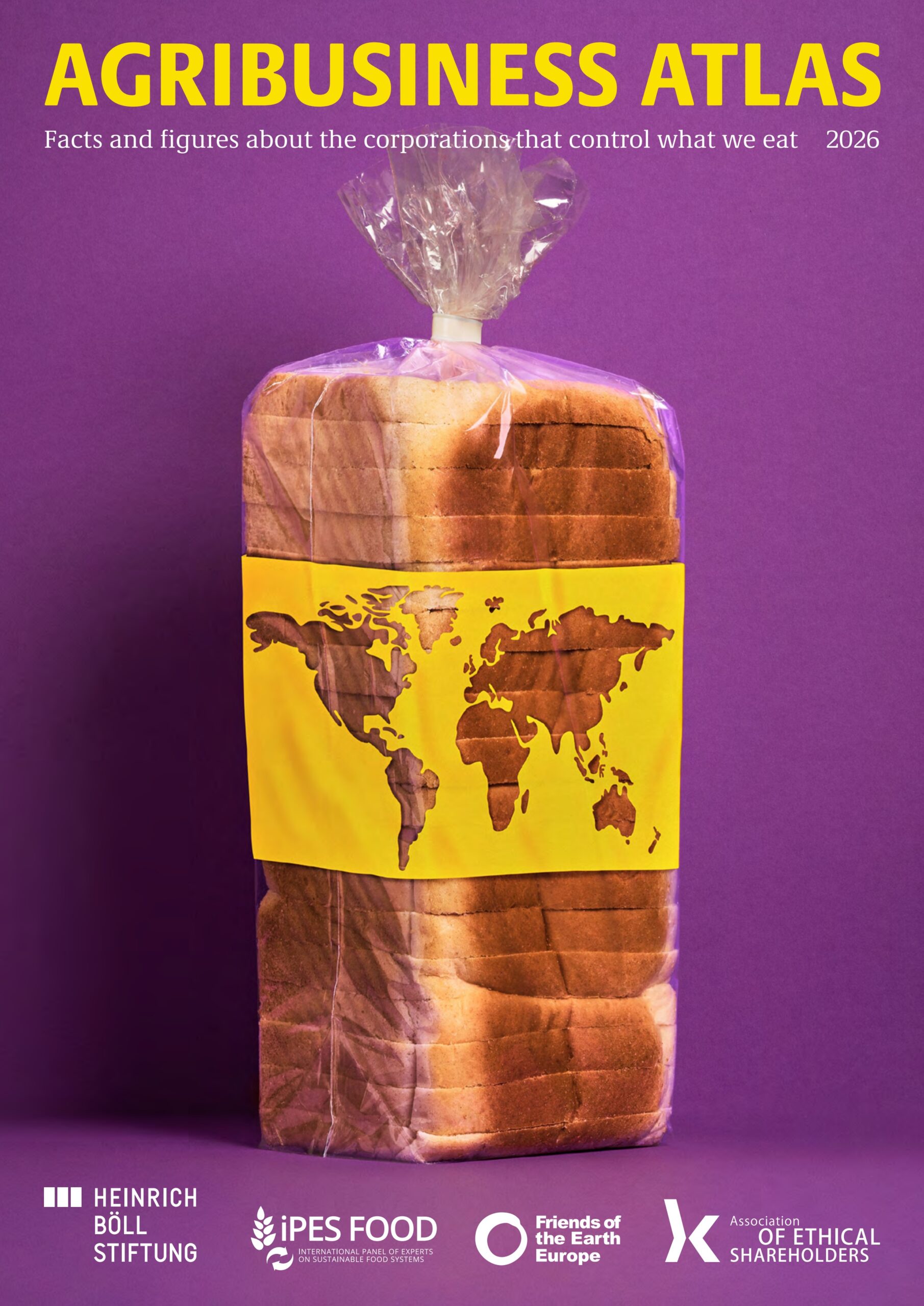
Agribusiness Atlas: Facts and figures about the corporations that control what we eat 2026
The Agribusiness Atlas 2026 details the unprecedented concentration of corporate power within global food systems. It examines how dominant firms influence policy, drive environmental degradation, and impact food security. The report advocates for democratic food governance, fair pricing for farmers, and public sector alternatives to curb corporate control.
Please login or join for free to read more.

OVERVIEW
Foreword
The global food system is currently facing its fourth wave of price crises in just 20 years. Corporate concentration has reached unprecedented levels, with just four corporations controlling 61 per cent of the global pesticide market, 56 per cent of the commercial seed sector, 43 per cent of farm machinery production, and 24 per cent of the global fertiliser market. This concentration leaves the food supply vulnerable to geopolitical shocks and economic speculation. Following the 2022 invasion of Ukraine, the world’s five largest agricultural trading corporations tripled their profits compared with their 2016–2020 average, while millions more faced acute food insecurity.
12 brief lessons about corporate power
A handful of corporate giants dominate the markets for pesticides, fertilisers, seeds, and farm machinery, entrenching an industrial model of agriculture. This power drives the production of ultra-processed foods, which yield high profits but contribute to around a third of deaths from cardiovascular disease in the European Union (EU). Agribusinesses also engage in extensive lobbying, spending more than 50 million euros between 2020 and 2023 to block stricter EU rules on pesticides. Furthermore, these players often exploit weaker environmental and health standards in the Global South.
History
The concentration of market power began in the 19th century with the introduction of new machinery and expanded in the 20th century through synthetic fertilisers and laboratory-developed pesticides. Stable markets emerged as early industry leaders like Bayer, BASF, and Deere & Company grew into dominant forces. Today, the global grain trade is dominated by a few influential trading houses, including Bunge, Louis Dreyfus, Cargill, and ADM.
Lobbying
Corporations and lobby groups often enjoy privileged access to policymakers. For example, the agrochemical industry launched an offensive against the EU’s Farm to Fork Strategy, which aimed to cut pesticide use by 50 per cent. By commissioning industry-backed studies, groups like CropLife Europe and Copa-Cogeca successfully derailed the proposal. In 2025, corporations generated 30 billion euros from pesticide sales in the EU.
Meat and dairy
The world’s largest meat and dairy corporations emit as much greenhouse gas (GHG) as entire countries. Together, the top 5 producers emit as much as fossil fuel giants like BP or Shell. Industrial livestock farming is a major contributor to emissions, particularly through methane, which has a global warming potential 81.2 times higher than CO2 over a 20-year period. In Europe, nearly 80 per cent of EU farm subsidies support livestock or feed production.
Blue food
The seafood sector is increasingly dominated by a small number of large corporations. Aquaculture production has more than quadrupled since the 1990s, surpassing capture fisheries in 2022. Consolidation is extreme; in 2023, just 15 salmon corporations accounted for two-thirds of harvest volumes. Overfishing continues as fleets push further offshore and target smaller species.
Water privatisation
The global bottled water market, dominated by Coca-Cola, Danone, Nestlé, and PepsiCo, now surpasses 300 billion euros in annual revenue. Bottled water is significantly more expensive than tap water, disproportionately affecting low-income households. In many regions, corporations secure long-term concessions to groundwater while local communities are denied access to safe piped water.
Pesticides
Agrochemical corporations export pesticides banned in the EU to countries with weaker safeguards. In 2024 alone, the EU authorised the export of 122,000 tonnes of 75 different pesticide active ingredients deemed too harmful for use under EU law. Around 60 per cent of these exports went to low-income countries.
Seeds
Just three corporations control 56 per cent of the global seed market. This control is maintained through biological barriers, such as hybrid seeds that lose desirable traits if replanted, and legal barriers like patents. Bayer and Corteva together hold 80 per cent of patents on genetically modified crops, giving them dominance over both seed and pesticide markets.
Animal feed
Global trade in animal feed, particularly soya, is controlled by the “Big Five”: ADM, Bunge, Cargill, COFCO, and LDC. Soya cultivation is a major driver of deforestation; soya imports account for a third of all deforestation linked to EU imports. In Brazil, soya fields span an area equal to over a tenth of the EU’s total land area.
Price and profit
Food prices are often shaped by power relations rather than supply and demand alone. In France, producers receive just 6.90 euros out of every 100 euros in food sales, a figure that was nearly twice as high thirty years ago. In the United States, 5 of the 10 lowest-paid occupations are found in the food industry.
Decarbonisation and digitalisation
The food system accounts for roughly a third of GHG emissions and consumes 15 per cent of the world’s fossil energy. Digitalisation, or “Agriculture 4.0,” involves the use of GPS sensors and AI, but these technologies are often controlled by a small number of corporations, increasing farm dependence on giants like Amazon, Microsoft, and Bayer.
China
Chinese state-owned enterprises, such as COFCO and Syngenta Group, have expanded their influence globally. China’s domestic food self-sufficiency fell to 65.8 per cent in 2020. To secure supplies, China has invested heavily in infrastructure and agricultural trade, particularly in Africa and Latin America.
Public groceries and procurement
Public sector initiatives can help fix broken markets. In Brazil, the National School Feeding Programme (PNAE) requires that at least 30 per cent of funds be used to purchase food directly from family farmers, a threshold raised to 45 per cent in 2026. This creates guaranteed markets for smallholders and improves student nutrition. Similarly, the proposal for publicly owned grocery stores in New York aims to sell essentials at cost price to ensure affordability.
Territorial markets and fair prices
In Africa, millions rely on territorial markets rooted in local cultures and informal trade, where women make up 70 to 80 per cent of traders. Strengthening these regional markets can enhance food security. To support farmers globally, stronger market regulations and fair pricing rules are needed to ensure they are paid above production costs and to drive a transition towards sustainable farming.




