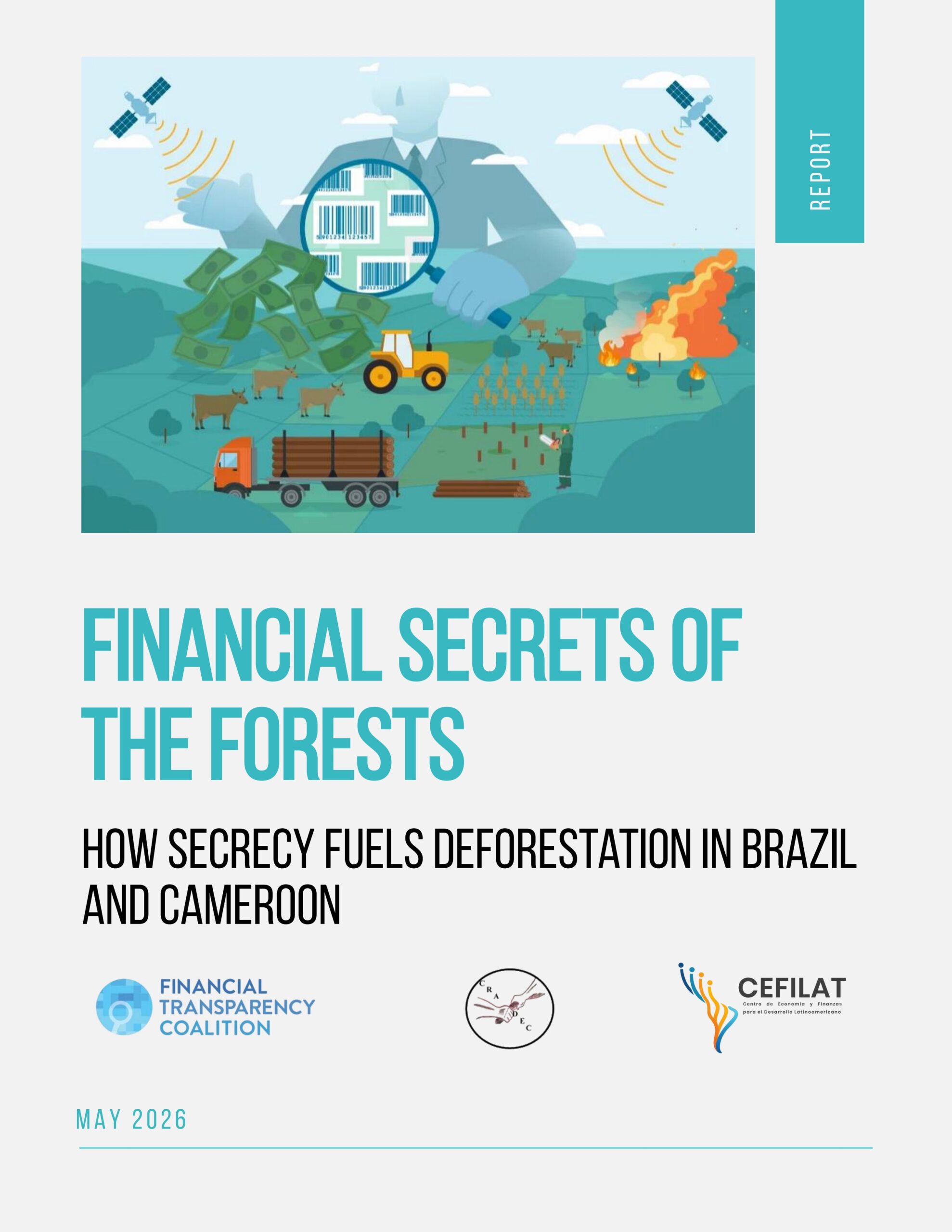
Financial secrets of the forests: How secrecy fuels deforestation in Brazil and Cameroon
This report examines illicit financial flows linked to deforestation in Brazil and Cameroon, estimating trade mispricing losses at US$289 million per year in Cameroon and US$214 million in Brazil. It finds that financial and land ownership secrecy enables illicit deforestation and recommends public beneficial ownership registries and supply chain transparency measures.
Please login or join for free to read more.

OVERVIEW
Introduction
According to Global Forest Watch, 4.3 million hectares of tropical primary forests were lost in 2025 alone—an area almost the size of Denmark (p.7). This report examines illicit financial flows (IFFs) linked to illicit deforestation in Brazil and Cameroon, using trade mispricing analysis and Geographic Information Systems (GIS) data. Trade mispricing losses were estimated at US$289 million per year in Cameroon (2013–2023) and US$214 million in Brazil (2013–2024) (p.7). The economic value of crops grown on illicitly logged land in Mato Grosso was estimated at US$10 billion for soy and US$4 billion for beef (p.7). The report argues that financial and land ownership secrecy is a key driver of illicit deforestation, and that international initiatives will fail without improved public access to company and asset registries.
Deforestation and illicit financial flows
IFFs are categorised into illicit tax and commercial practices, illegal market activities, corruption, and exploitation-type financing (p.9). The UNEP estimates illicit logging accounts for 15–30% of all logging, representing US$51–US$152 billion in IFFs annually (p.9). The FATF classifies environmental crimes as money laundering offences, and a 2021 FATF survey of 44 countries found that most destination countries had not incorporated environmental crimes into money laundering legislation (p.11). Research found that 68% of all investigated foreign capital flowing into nine leading soy and beef companies in the Brazilian Amazon was transferred from tax havens between 2000 and 2011 (p.10).
Brazil
Brazil lost 1.6 million hectares of tropical primary forest in 2025, the most of any country globally (p.7). Under President Bolsonaro (2019–2022), unexplained trade discrepancies in timber exports amounted to US$2.5 billion, a gap that was eliminated by 2024 (p.14). Approximately US$1.28 billion of timber exports were estimated to have originated from illicitly logged land in 2024 (p.14).
In Mato Grosso, plots lacking deforestation permits between 2010 and 2023 accounted for 48% of soy production area and 15% of intensive grazing pastureland (p.15). The value of soy on land without permits was R$58.6 billion (US$10.3 billion), and beef R$22.4 billion (US$3.9 billion) (p.15–16).
Beneficial ownership data is not publicly accessible in Brazil, limiting traceability. Overlapping land claims account for more than 50% of registered territory (p.14). A case study of Fazenda Santa Silvia in Cocalinho, Mato Grosso—where 3,168 hectares were cleared illegally between October 2022 and July 2023—illustrates that identifying supply chains requires on-the-ground investigative work, as publicly available data alone is insufficient (p.18–19).
Cameroon
Cameroon ranked sixth globally for tropical primary forest loss in 2025, losing 105,000 hectares with associated carbon dioxide emissions of 130 MtCO₂e (p.20–21). Trade mispricing analysis found IFFs averaging US$289 million per year between 2013 and 2023 (p.21). Cumulative trade gaps included US$1.2 billion with China, US$760 million with Vietnam, US$504 million with EU countries, and US$125 million with the United Kingdom (p.22).
Beneficial ownership registries exist but are not public, enabling foreign companies to use local shell companies to access timber concessions. Five sanctioned companies held 20,710 hectares in Sales of Standing Volume concessions, representing 9% of the national total (p.28). Cameroon’s Ministry of Forestry and Wildlife did not respond to the authors’ information requests, further limiting transparency.
Conclusions and recommendations
The report sets out five recommendations: establishing centralised public beneficial ownership registries; implementing public country-by-country tax reporting for large multinationals; incorporating illicitly deforested land into supply chain due diligence obligations; developing a Global Asset Registry; and publishing data on environmental fines and sanctions, with importing countries recognising these as violations under their timber regulations (p.30).