

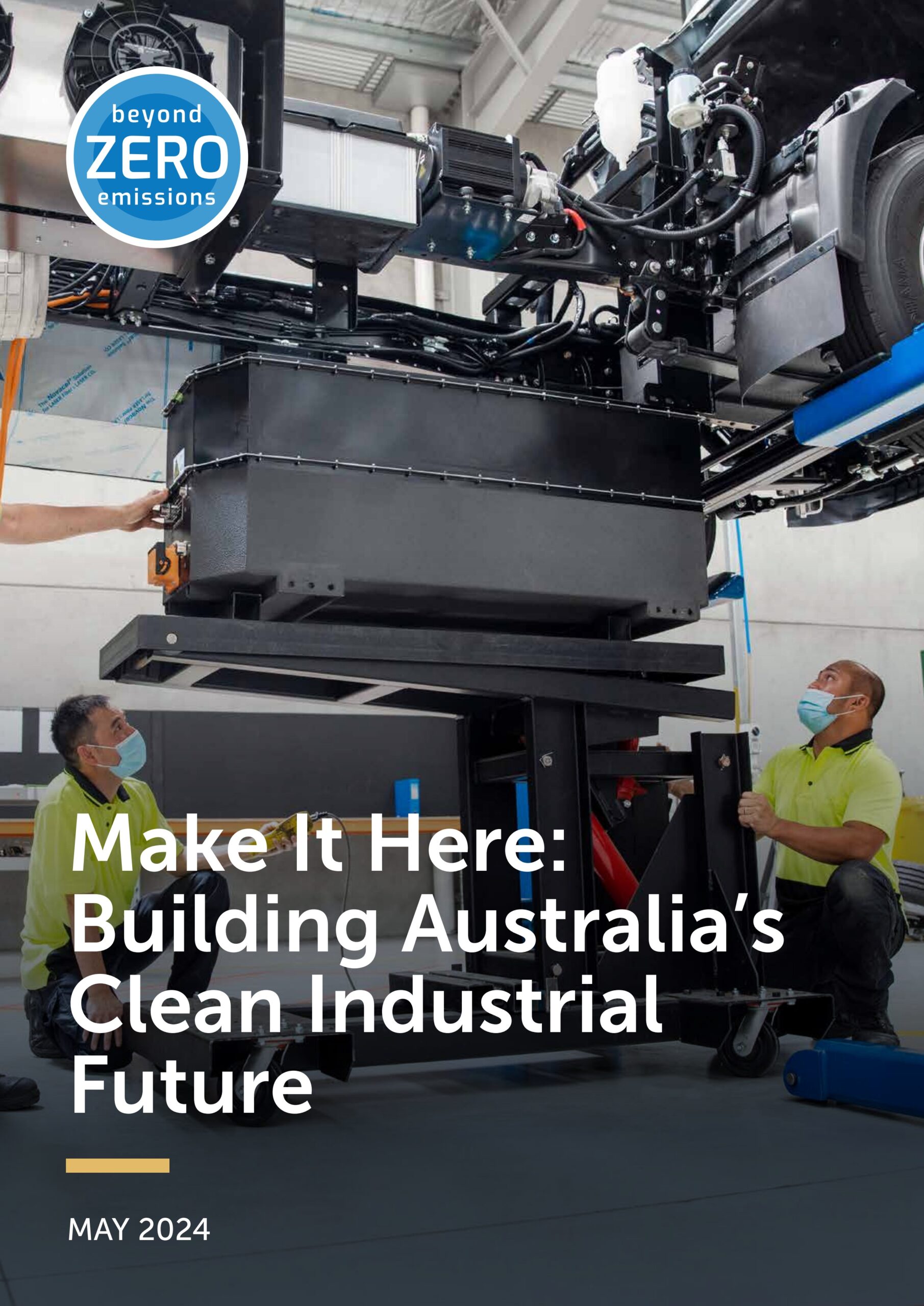
Make it here: Building Australia’s clean industrial future
This report outlines Australia’s potential to generate $215 billion by 2035 by manufacturing clean technologies onshore. By leveraging mineral wealth and establishing Renewable Energy Industrial Precincts, Australia can shift from exporting raw materials to producing high-value batteries, wind turbines, and electric vehicles, creating 53,000 regional jobs.
Please login or join for free to read more.

OVERVIEW
Executive summary
Beyond Zero Emissions (BZE) identifies a once-in-a-generation opportunity for Australia to transition from a “dig and ship” model to a “mine and make” economy. By supporting five onshore cleantech supply chains—solar, wind, batteries, heat pumps, and commercial electric vehicles (CEVs)—Australia could generate $215 billion in revenue and create 53,000 jobs by 2035. The report recommends providing time-limited financial support to build competitive industries, creating demand certainty for Australian-made products, locating manufacturing in clean industry hubs, and establishing circular economies for each supply chain.
The global race to deploy cleantech and lower emissions
Global demand for clean technology is forecast to grow more than three-fold by 2035. To align with a 1.5°C warming target, the world requires massive additional capacity, including 10,400 GW of solar, 4,300 GW of wind, and over 78,000 GWh of battery storage for energy systems and transport. While China currently leads these supply chains, the necessary scale of deployment creates significant opportunities for new players to embed themselves in manufacturing. For Australia to meet emission reduction targets, onshore deployment needs must increase significantly: over 3-fold for solar, 9-fold for wind, 16-fold for batteries, and 27-fold for heat pumps by 2035 compared to 2022 levels.
Cleantech manufacturing needs Australian minerals and materials
Australia holds the world’s largest reserves of iron ore and nickel, and ranks second for vanadium, lithium, cobalt, silver, and copper. Despite this wealth, the nation currently captures very little supply chain value; for example, in the battery supply chain, 96% of value is captured overseas during processing and component manufacture. Expanding into refining and processing could unlock $215 billion of value from raw mineral reserves. Furthermore, Australia has the potential to grow a green export mix worth $333 billion per annum by 2050, which is almost triple the value of fossil fuel exports in 2020/21.
Repowering Australian manufacturing
Concentrated global cleantech supply chains and projected material shortages represent a risk to sovereign security. However, this risk can become an opportunity if Australia invests in onshore manufacturing. South Australia is cited as a leading example of this transition; its shift to renewables and energy storage is attracting new industries such as green steel, mining, and green hydrogen, which helps distribute the costs of energy infrastructure across a wider customer base.
Benefits of seizing the opportunity now
Wind and batteries represent the most impactful opportunities for expanding onshore manufacturing. Batteries alone could generate $114 billion in revenue and 20,000 jobs by 2035 through the establishment of up to five gigafactories. Wind energy could meet 36% of local demand, generating $35 billion and 2,000 jobs. Other sectors include solar ($14 billion revenue, 6,000 jobs), heat pumps ($17 billion revenue, 7,000 jobs), and CEVs ($37 billion revenue, 18,000 jobs). Local manufacturing ensures energy security and protects against global supply chain disruptions.
Location is key in the rollout of renewables
The development of infrastructure must be efficient, coordinated, and mindful of nature and communities. Renewable Energy Industrial Precincts (REIPs) are proposed as clean industry hubs where energy-intensive manufacturing facilities co-locate to share low-cost renewable energy. The report emphasises the need for social acceptance, including heeding First Nations rights and ensuring community benefits through free, prior, and informed consent. Transparent land use mapping is a critical tool for identifying optimal locations with minimal impact on biodiversity and agriculture.
Building on common strengths
Australia excels at mining but must bridge gaps in advanced manufacturing and “giga-scale” production. Partnerships with world-leading manufacturers are essential to develop onshore skills and capacity, particularly for the solar industry. Maintaining high environmental, social, and governance (ESG) standards will provide a competitive advantage in global markets. Additionally, a circular economy is necessary to manage end-of-life materials, reducing the need for new mining and ensuring long-term material security.
Making it happen
To realise these benefits, the report recommends supply-side subsidies, such as production credits, to help local industry compete with heavily subsidised international markets. Demand-side mechanisms and local content incentives are also necessary to attract investors. Establishing a network of REIPs in regional communities previously reliant on fossil fuels can revitalise these economies, potentially supporting a new clean export market worth $333 billion a year by 2050.




