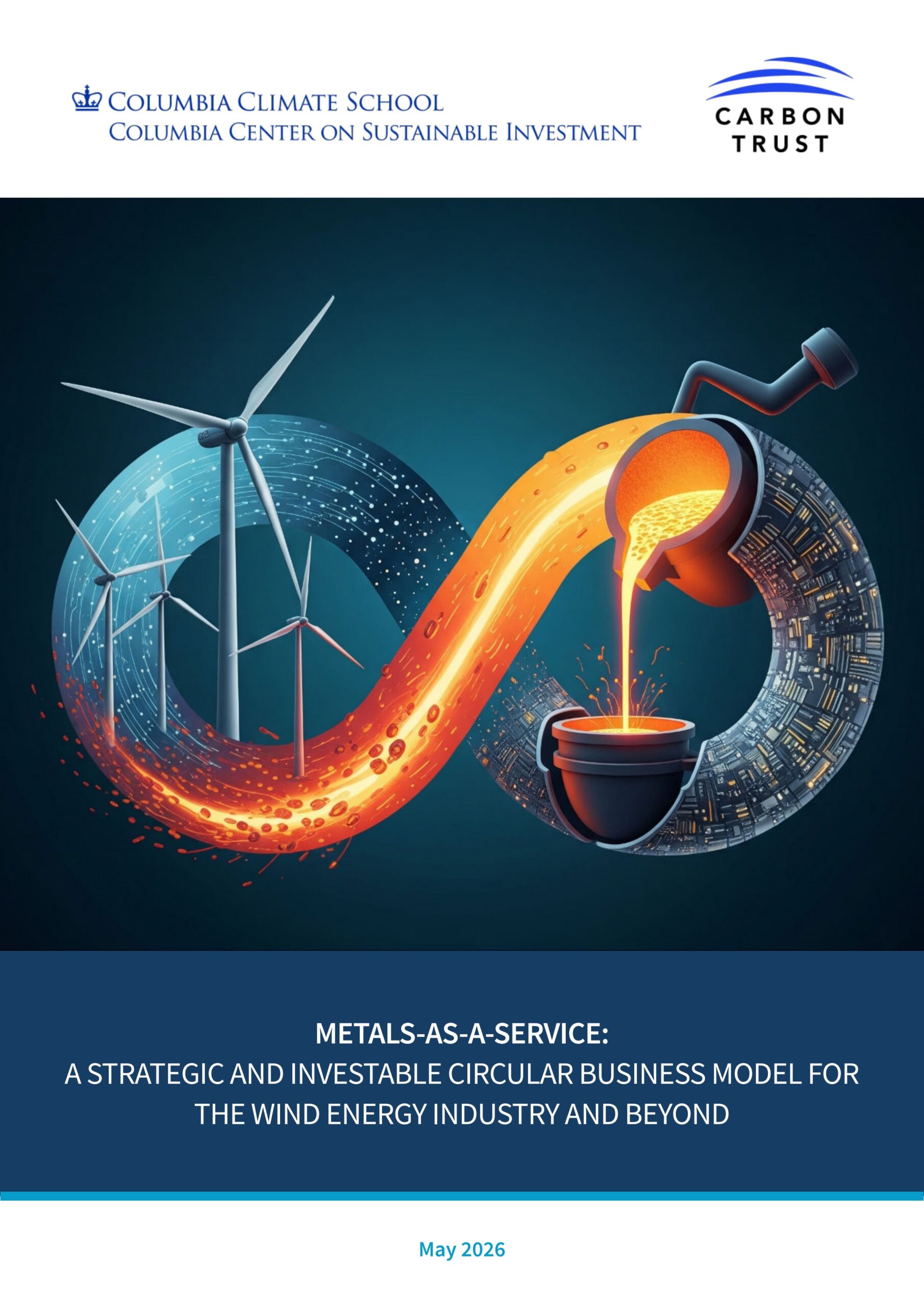
Metals-as-a-Service: A strategic and investable circular business model for the wind energy industry and beyond
Metals-as-a-Service (MaaS) proposes a circular business model for the wind energy sector and beyond, in which metal ownership is retained by a Special Purpose Vehicle throughout the asset lifecycle. The model converts metal procurement from capital expenditure into a service-based structure, enabling securitisation, improved supply security, and circular value creation.
Please login or join for free to read more.

OVERVIEW
Why a new model is needed
Global metal demand is rising sharply with the energy transition, with roughly 6.5 billion tonnes of end-of-use materials required to support it (p.6). Large mining projects typically take up to two decades to reach commercial production, and in copper, average grade declines of ~30% have been reported over recent decades (p.6). The traditional linear ownership model leaves recycling too late in the chain, creating material bottlenecks and continued dependence on primary production.
Introducing the MaaS concept and its key principles
Metals-as-a-Service (MaaS) is a circular business model in which metal ownership remains with a single actor — the Asset Owner (AO) — throughout its lifecycle. Only use rights are granted to the lessee under a lease agreement requiring periodic fee payments and a contractual obligation to return or enable metal recovery at end-of-use (p.8). This keeps the AO financially motivated to recover metal across multiple cycles.
Special purpose vehicle: The backbone that MaaS requires
A Special Purpose Vehicle (SPV) acts as the independent legal entity housing the MaaS framework. It standardises contracts, manages lifecycle integration, and enables structured financing arrangements — ring-fencing risks from the sponsor’s core operations (p.9–11).
Ensuring the financial viability: An overview
Three conditions underpin MaaS viability: fungibility within defined quality bounds, stock accumulation, and innovative financing. Digital Product Passports (DPPs), enabled through blockchain and IoT tagging, support traceability and investor confidence (p.12–13). Stock accumulation creates a self-reinforcing cycle — more stock enables more contracts, which generate more cash flow to fund further stock growth.
Building MaaS contracts
MaaS contracts govern liability, payment calculation, and performance measurement. Proposed clauses cover payment terms, service levels and KPIs, ownership retention, inspection and monitoring, decommissioning and recovery, and force majeure provisions (p.14).
Valuing MaaS contracts
MaaS contracts resemble interest-bearing instruments, with lease payments acting like coupons and recovered metal like principal. Key value drivers include lease payments, recovered metal value, recovery rate assumptions, and spot price projections at maturity (p.15). Contracts should be hedged against interest rate movements using instruments such as plain vanilla swaps.
Building the metals bank
The Metals Bank is a centralised pool of owned metal inventory supporting the leasing system. Three market entry points exist: asset-centric, product-centric, and recovery-centric. The concept of “variable yield” — the gap between selling and leasing returns — determines the model’s attractiveness relative to linear alternatives (p.18–21).
Pathway towards MaaS: Observations from the wind sector
Market conditions in the wind sector favour circularity. Reclaimed materials such as surplus steel pipe can deliver around 20% cost savings and significantly lower embodied emissions (p.22). Operations and maintenance costs account for around 30% of asset lifetime costs (p.23). Piloting MaaS involves staged steps including SPV formation, capital raising, metal procurement, reinvestment, and securitisation.
Scaling MaaS: Financing MaaS with bonds
SPVs can issue Asset-Backed Securities (ABS) by pooling securitised MaaS contracts, featuring credit tranching, excess spread, and overcollateralisation (p.30). Covered bonds offer a lower-cost but less flexible alternative (p.32). The Hornsea 1 Offshore Wind project raised nearly £2 billion through an SPV securitising future electricity sales as a comparable precedent (p.29).
MaaS as a journey: Evolution of SPV structures
SPV structures evolve from Limited Liability Companies (LLCs) suited to proof-of-concept (0–3 years), to Master Limited Partnerships for growth stage (3–5 years), to Commodity Investment Trusts for mature markets (5+ years) (p.33–35).
Stakeholder benefits of MaaS
MaaS delivers lower upfront CAPEX, improved supply security, aligned circularity incentives, clearer risk allocation, stable long-term revenue streams, a new investable asset class, and regulatory and strategic advantage for metal-intensive industries (p.37).
Conclusion
MaaS offers the wind sector a route to expand responsibly and resiliently, unlocking a new asset class that merges industrial stewardship with long-term financial performance (p.38).