

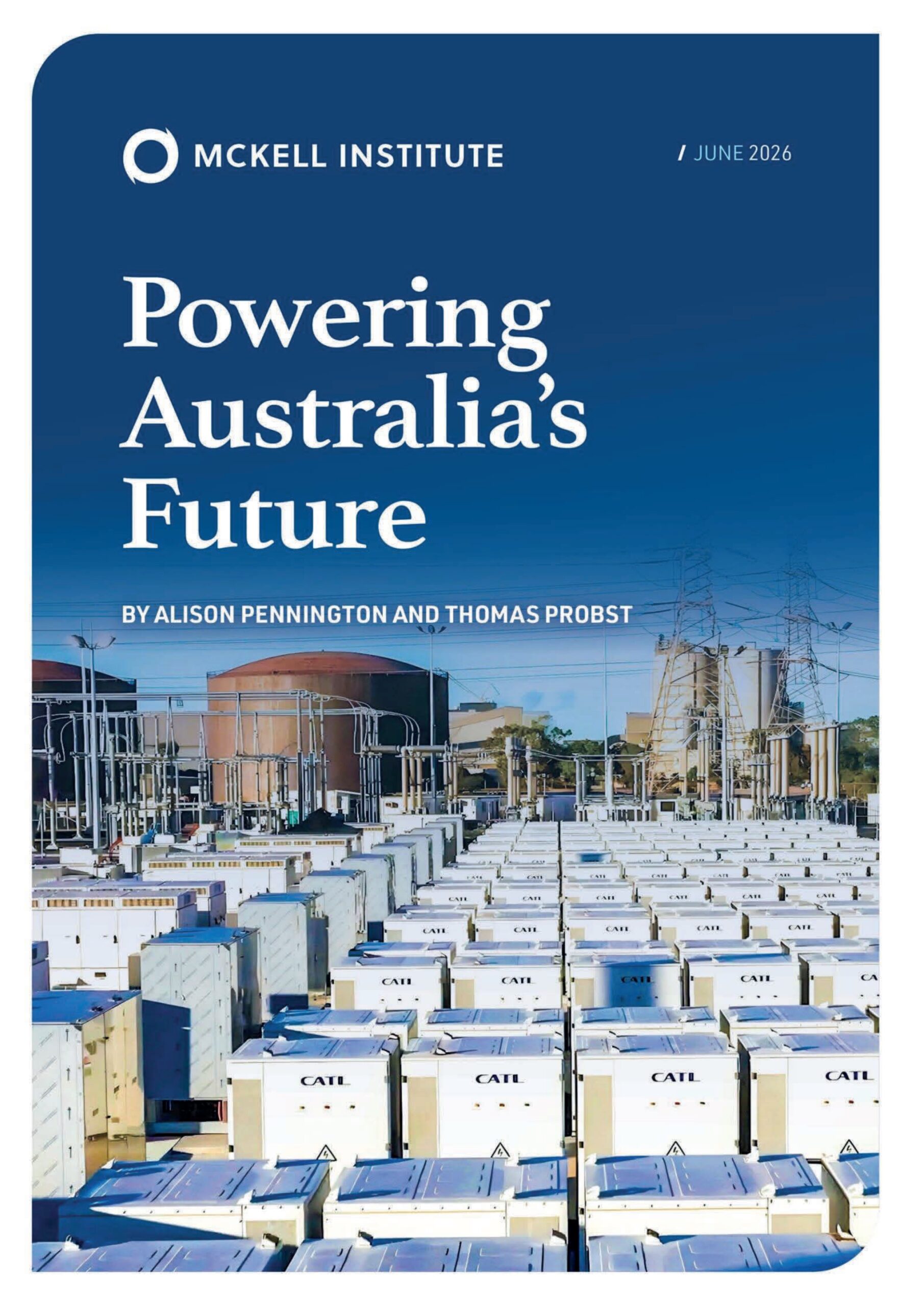
Powering Australia's future
This report proposes establishing ‘Sovereign Power’, a Commonwealth entity to build firmed renewable generation for Australia’s heavy industry. By leveraging lower public borrowing costs, it could provide electricity at $66/MWh, 44 percent below market rates, securing sovereign capability and supporting the ‘Future Made in Australia’ framework.
Please login or join for free to read more.

OVERVIEW
Summary
Australia currently possesses an ambitious industrial policy through the Future Made in Australia (FMIA) framework and the National Reconstruction Fund (NRF), both designed to transform the economy. However, current electricity market settings are unable to provide power at the prices necessary to secure the viability of heavy industry. The Middle East conflict has resulted in the third major global energy price shock in less than a decade, exposing Australia’s industrial base to extreme volatility. This report proposes the establishment of ‘Sovereign Power’, a new Commonwealth entity to build and own firmed renewable generation. By leveraging the Commonwealth’s lower cost of capital and longer investment horizons, Sovereign Power can deliver electricity at prices that make Australian heavy industry globally competitive.
Key findings
The report finds that the private market is failing to provide long-term energy contracts at prices that make energy-intensive manufacturing commercially viable. Despite a commitment of more than $22 billion in FMIA credits and grants, renewable generation is not being built fast enough because it lacks a direct link to major industrial demand. Currently, while the Capacity Investment Scheme (CIS) has awarded 20 GW, only 3.3 GW (17 percent) has started construction. Furthermore, the Commonwealth and state governments have already committed more than $5 billion in ad hoc support since 2024 to keep aluminium smelters and other energy-intensive facilities operating. Moving to a purpose-built institution would deliver more efficient and permanent outcomes for the nation’s industrial future.
Recommendations
The report recommends establishing Sovereign Power as a new corporate Commonwealth entity through standalone legislation. Its primary purpose should be providing cost-recovery electricity to strategic industrial customers, rather than acting as a general-purpose generator or retailer. Priority customers should include existing trade-exposed, energy-intensive heavy industries downstream of mining, such as aluminium smelters, steel plants, alumina refineries, and cement works. Sovereign Power should also serve new industries supported by the FMIA National Interest Framework, including green hydrogen and critical minerals processing. The entity should be funded through a direct Commonwealth equity injection, potentially redirecting underutilised capital from the National Reconstruction Fund.
Part 1: Why sovereign industrial capability matters
Sovereign capability involves controlling the inputs fundamental to an economy: raw materials, labour, and electricity. While Australia exercises control over raw materials and labour, electricity remains a significant gap. Generation in the National Electricity Market (NEM) is overwhelmingly private and increasingly foreign-owned. Data shows that at least 41 percent of renewable generators are foreign-owned or controlled, with foreign state-owned entities from countries such as China and Saudi Arabia holding significant stakes. Heavy industry supports over 200,000 direct and indirect jobs and tens of billions of dollars in economic activity, anchoring regional communities across the country. Affordable sovereign energy is now the binding constraint on attracting new industrial investment and building a high-productivity economy.
Part 2: The market is failing heavy industry
Failure to improve energy security is driving industrial decline, with manufacturing falling to just 5.1 percent of GDP in 2025. High energy costs are a primary driver; since 2022-23, approximately 1,400 manufacturing firms have become insolvent. The private market’s inability to provide viable long-term power purchase agreements (PPAs) is demonstrated by the case of Tomago Aluminium in New South Wales, which required government intervention to avoid closure. Private developers face structural mismatches between their financial incentives and the needs of energy-intensive industry, including high borrowing costs and the ‘tenor gap’ in contract lengths.
Part 3: Sovereign power
Sovereign Power would build firmed renewable capacity—generation paired with battery storage—sized to match the baseload needs of its industrial customers. It would procure contractors to build these assets through competitive tenders while embedding local content and labour standards. The entity would sell electricity through 15-to-25-year PPAs priced on a cost-recovery basis. This model would sit alongside existing programmes like the CIS and ESEM but would fill the specific gap of providing direct, affordable, firmed clean electricity to strategic industrial users.
Part 4: Modelling the cost difference
Public borrowing has averaged 2 percentage points cheaper than private borrowing over the last 13 years. On the debt component alone, this spread translates to annual savings of $460 million on an illustrative $23 billion investment. A publicly owned entity also eliminates the equity layer entirely, removing the requirement for commercial dividends. Illustrative modelling suggests a sovereign PPA price of approximately $66/MWh, which is roughly 44 percent below an equivalent private sector PPA of approximately $117/MWh. This price advantage is driven by lower cost of capital, reduced firming costs, and the absence of a commercial margin.
Conclusion
Australia’s heavy industry is caught between an aging coal fleet and a renewable transition that is currently too slow and expensive. Establishing a public clean energy capability allows the government to secure economic foundations for decades. Sovereign Power would unite disparate initiatives like the FMIA and NRF under a single umbrella, advancing the renewable transition while ensuring sovereign industrial capability and securing new investments that generate high-quality regional jobs.




