

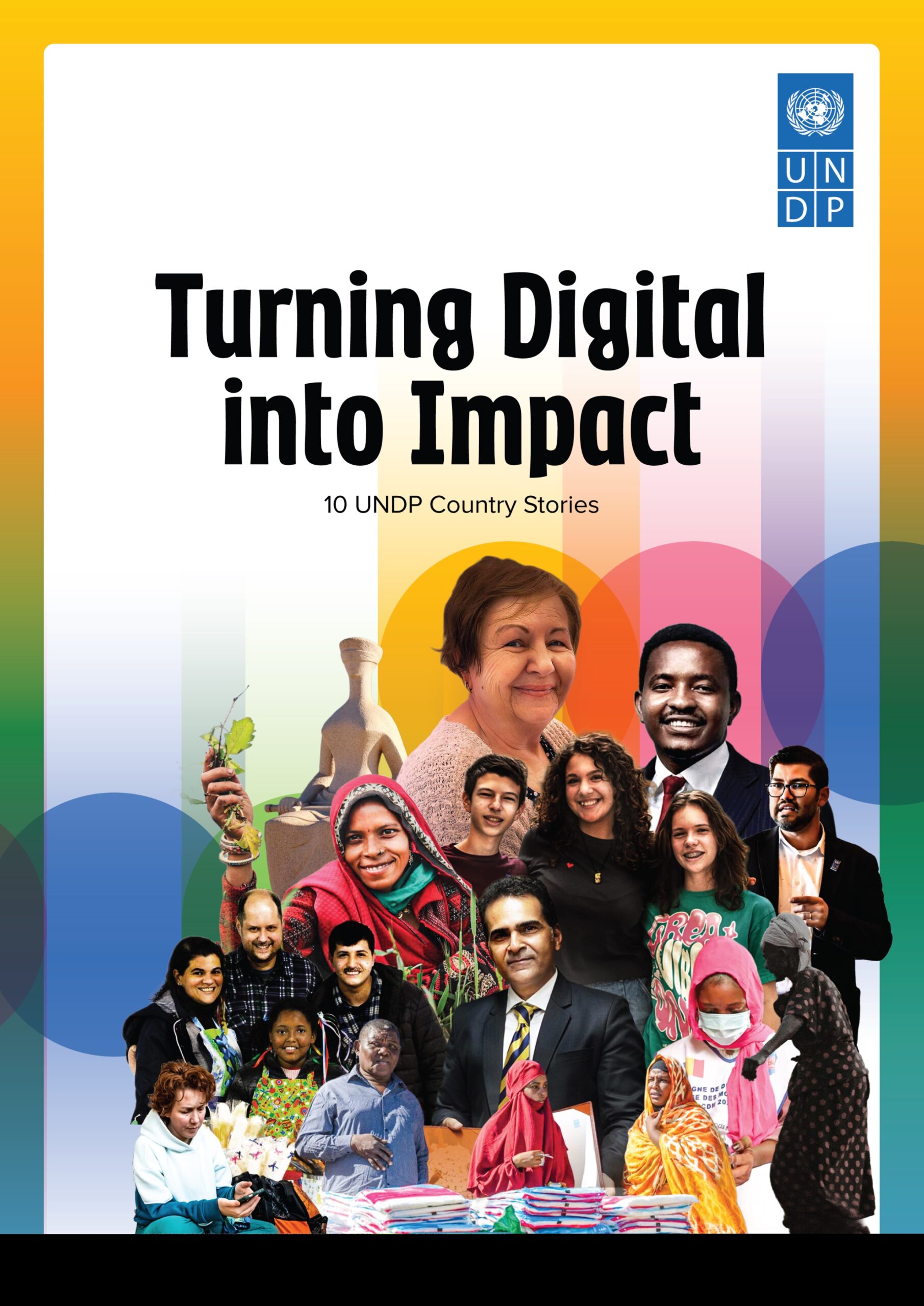
Turning digital into impact: 10 UNDP country stories
This report details ten UNDP initiatives demonstrating how digital transformation drives social impact. Covering nations like Brazil, India, and Ukraine, it showcases human-centred technological investments that improve justice systems, healthcare delivery, and climate resilience. The findings emphasise that institutional change and trust-building are as critical as the technology itself.
Please login or join for free to read more.

OVERVIEW
Preface
Digital technology transformation is not automatic or evenly distributed. This compendium documents deliberate, evidence-grounded digital investments across ten countries, exploring how these tools benefit those who need them most. It highlights that while technology is often the straightforward component of progress, the more challenging work involves institutional change, building trust, and persuading siloed systems to serve people. These stories demonstrate that digital success occurs when solutions are designed around the people they serve, implemented with patience, and held accountable by evidence.
From court backlogs to justice without delay in Brazil
Brazil’s justice system, managing tens of millions of cases annually, faced significant strain with an average of 6,000 cases per judge. The Justice 4.0 programme was launched to unify over 50 separate court management systems into a shared national cloud platform, PDPJ-Br. Key innovations include PrevJud, which reduced the average time to execute social security court decisions from years to less than two minutes. Additionally, the digitisation of domestic violence risk assessments through FONAR decreased the average time to grant protective measures from sixteen days to just two or three days. By late 2022, 111 AI-powered tools were assisting case processing across 53 courts.
The system behind the net: Chad’s digital push against malaria
In 2023, the Chad Ministry of Health digitised its national mosquito net distribution campaign to replace a slow, paper-based process. By using digital tablets and the DHIS2 platform, health workers could record deliveries in real-time, even while offline. This initiative reached 9.4 million people and geolocated 3.5 million households. The system proved critical when nearly half a million people fled conflict in Sudan, allowing officials to quickly identify and meet the urgent needs of displaced populations during peak malaria transmission seasons through real-time tracking of household coverage and stock levels.
Powering the next stage of green growth in Egypt with digital
Egypt’s economy relies heavily on 3.8 million micro, small, and medium-sized enterprises (MSMEs), which account for 98 per cent of private-sector businesses. The Green Growth and Jobs Accelerator Project (GGJAP) provides digital tools to help green businesses measure environmental impact and attract investment. In 2024, the programme helped secure $9 million in confirmed investment deals for green SMEs, with six enterprises reaching full investment readiness. One participant, Mezatech, used these digital impact measurement tools to close a funding round and launch a refurbishment brand with a carbon footprint 70 per cent smaller than new devices.
Digital services drive small business growth in Guatemala
Guatemala has focused on integrating government agencies to enable better information exchange and reduce duplicated workflows. Four social programmes were digitised and integrated, leading to a 161 per cent increase in monthly beneficiary registrations at the Ministry of Social Development. Complementary digital literacy workshops, such as “My First Digital Steps”, have empowered local entrepreneurs. Across seven sessions in 2025, the programme had 217 participants, of whom 87 per cent were women. These participants have used their new skills to expand market reach through social media platforms like TikTok.
Climate data that belongs to farmers who need it most
In India, the DiCRA (Data in Climate Resilient Agriculture) platform was developed as an open-source digital public good. It pools over 20 agricultural and climate data layers, providing farm-level intelligence to help smallholders adapt to shifting weather patterns. The platform now informs agricultural decisions across approximately 50 million hectares of farmland nationwide. By using an open-source collaborative model, the system was built at roughly 10 per cent of the cost of a comparable proprietary system. In Telangana, DiCRA data was used to guide approximately $71 million in public agricultural investment.
Elevating the voices of local communities through AI to inform decision-making
Indonesia’s STRIVE initiative uses artificial intelligence to digitise the “deep listening” process in village planning. This tool allows residents in remote areas to submit their development priorities via text, voice, or photos. Between 2023 and 2025, the pilot brought 3,541 people into planning sessions across 100 villages, documenting over 2,000 local development initiatives for the first time. This ensures that the voices of women, who are often excluded from traditional sessions, and marginalised groups are included in official budgeting processes that determine how public money is spent.
Finally, i exist in malawi
Malawi implemented a massive logistical operation to register nine million adults for national IDs within 180 days. Using solar-powered biometric kits, the programme established a digital backbone that now covers over 98 per cent of the adult population. The system has already generated over $42 million in verified savings from reduced fraud and better targeting. Projected annual gains could reach $300 million as the ID becomes further embedded in public services like birth registration, health, and land records. The rollout also created over 4,500 jobs for young Malawians operating the registration kits.
When natural disasters strike, digital delivers
The Maldives developed the Disaster and Loss Assessment (DALA) platform to replace manual, paper-based reporting across its 1,200 islands. Previously, understanding the full national picture following a disaster could take up to three weeks; the new cloud-based system has reduced the time to process assessments to just one or two days. Currently, 187 island councils use DALA, allowing the National Disaster Management Authority to direct shelter materials, cash assistance, and medical supplies to specific households in near real-time as reports are recorded in the field.
Digital skills for every stage of life in Serbia
Serbia has built a comprehensive digital skills ecosystem reaching all generations. The Petlja platform now supports computer programming classes in 90 per cent of primary schools, reaching over 200,000 users. For adults, the National IT Retraining Programme has helped 3,000 individuals with no prior background, with 46 per cent being women. Additionally, the “Digital Expedition” caravan travelled to 26 towns, teaching 35,000 citizens how to use electronic IDs, shop online, and protect personal data. Around 10,000 civil servants have also been trained in eGovernment and digital skills.
How digital systems help governance hold through crisis in Ukraine
Ukraine’s Diia app, launched in 2020, became a vital lifeline during the 2022 conflict. It enabled over 1.4 million internally displaced persons to register and apply for monthly financial support in one step. The platform has digitised 5.8 million civil records from occupied regions and currently offers more than 74 digital services developed since 2021. This digital infrastructure has ensured that essential state support, including veteran IDs and social assistance, remains accessible safely and conveniently even when physical offices are closed or destroyed by war.




