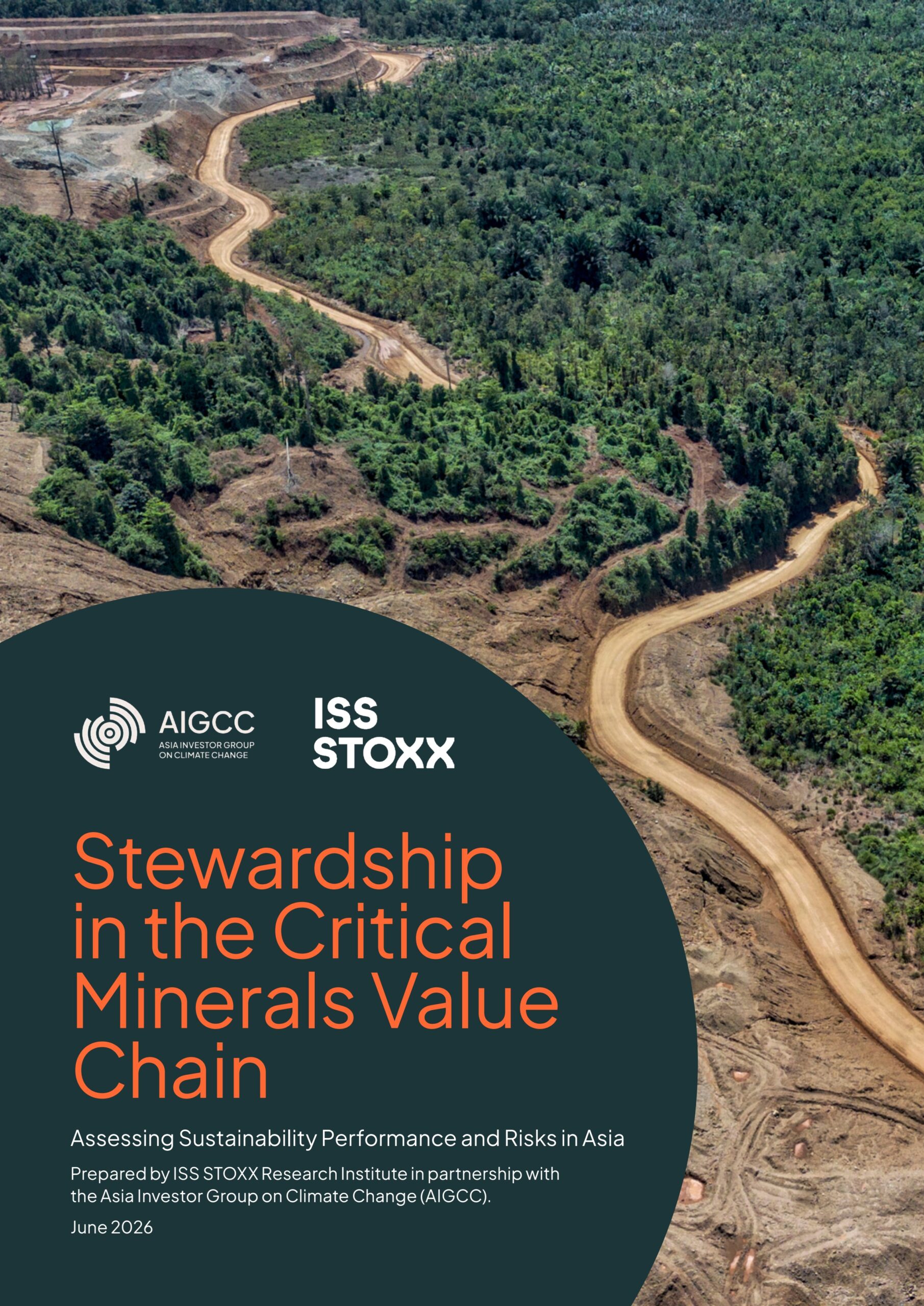
Stewardship in the critical minerals value chain: Assessing sustainability performance and risks in Asia
This research examines sustainability risks in Asia’s critical minerals value chain, focusing on nickel, cobalt and copper. Utilising IRMA-aligned assessments and geospatial data, it highlights gaps between corporate policy and implementation, intensifying physical climate risks, and nature dependencies, providing actionable stewardship priorities for institutional investors in the region.
Please login or join for free to read more.

OVERVIEW
Introduction
Developed by the ISS STOXX Research Institute in collaboration with the AIGCC, this report provides a strategic overview of sustainability performance within the critical minerals industry in Asia. It evaluates 14 mining operators at an issuer level against the Initiative for Responsible Mining Assurance (IRMA) Standards and screens 297 mine assets for physical climate risk. The research aims to help investors navigate the complex landscape of the energy transition by identifying material risks and stewardship priorities in the region.
Critical minerals in Asia’s energy transition: Demand, risks, and supply chain dynamics
Demand for critical minerals is projected to increase sixfold by 2050, with their market value reaching USD400 billion. The report focuses on nickel, cobalt, and copper, which are essential for electric vehicles (EVs) and renewable infrastructure. Indonesia dominates the nickel market, holding over 22% of global nickel reserves and accounting for 60% of global production in 2024. Meanwhile, China accounts for nearly 60% of global refined copper demand. The supply chain is characterised by price volatility, long lead times, and structural fragilities, making it vulnerable to geopolitical and environmental shocks. Policy shifts, such as Indonesia’s export bans on nickel ore and China’s strategic stockpiling of Class 1 nickel reserves, underscore the growing importance of resource nationalism and supply security.
Critical minerals mining in Asia: An Irma-aligned sustainability assessment
An assessment of 14 mining operators reveals a consistent gap between policy adoption and operational implementation. While nine operators have formal human rights policies, only seven demonstrate strong due diligence practices, and five are classified as laggards. Modern slavery risk is a significant concern, as all 14 operators fall under high location risk due to their core operations being in areas with elevated prevalence. Performance on social responsibility is mixed; although 13 operators have policies on forced and child labour, practical measures to prevent these abuses are weak, with seven companies identified as laggards. In terms of environmental responsibility, greenhouse gas (GHG) emission intensity is a relatively strong area with 10 leaders, but strategic action remains limited, as seven companies lack credible GHG reduction targets and action plans. Site closure and reclamation planning was found to be the weakest performance area across the assessed group.
Nature risks in critical minerals mining: Dependencies and impacts
Mining operators both rely on and significantly affect nature. Analysis using the Biodiversity Impact Assessment Tool (BIAT) shows that the sector’s revenue dependency is primarily tied to regulation and maintenance services (63%) and provisioning services (35%). Specifically, surface water flow maintenance has the greatest material revenue dependency. Mining activities simultaneously drive nature loss through land-use change, which accounts for 90.10% of nature loss impact drivers, followed by pollution at 5.20% and climate change at 4.60%. Degradation of these ecosystem services can lead to operational disruptions, increased costs, and social conflicts over water scarcity, highlighting the urgent need for sustainable resource management.
Geospatial data-climate risk exposure assessment
Physical climate risks are set to intensify significantly under a high-emissions RCP 8.5 scenario. Geospatial analysis of 297 Asian mine assets indicates that exposure to water stress and heatwaves will grow over the next 15 to 30 years. The number of assets facing high water-stress risk is projected to nearly triple, while low-risk assets will decline by almost half. Similarly, high-risk assets for heatwaves are expected to increase by over 130%. These trends threaten operational continuity and cost structures, necessitating mine-level adaptation strategies and site-specific resilience planning to mitigate financial and physical vulnerabilities.
Investor engagement on critical minerals mining: Case studies
Stewardship remains a vital tool for managing portfolio risks. Case studies highlight the efforts of EOS at Federated Hermes and ISS STOXX’s Norm-Based Engagement. EOS has focused on responsible cobalt and nickel sourcing since 2017, encouraging transparency, traceability, and the management of socioeconomic risks. Meanwhile, ISS STOXX engaged in 69 cases related to mining activities between 2020 and 2025, with half of these covering environmental violations. Common topics of engagement include water management, pollution remediation, and Indigenous rights. Investors are encouraged to seek Free, Prior and Informed Consent (FPIC) from Indigenous Peoples and to push companies for clearer board accountability and enhanced transparency.
Conclusion
The report concludes that while critical minerals are indispensable for the global energy transition, the sector faces significant sustainability and operational challenges. Investors are advised to strengthen due diligence on mining exposures, prioritising engagement where gaps between policy and practice are greatest. Suggested actions include urging companies to follow rigorous industry standards like IRMA, tilting capital towards operators with strong long-term sustainability performance, and integrating nature- and climate-risk analytics into core investment decision-making processes. Active stewardship is essential for shaping more responsible practices and reducing systemic supply chain vulnerabilities.