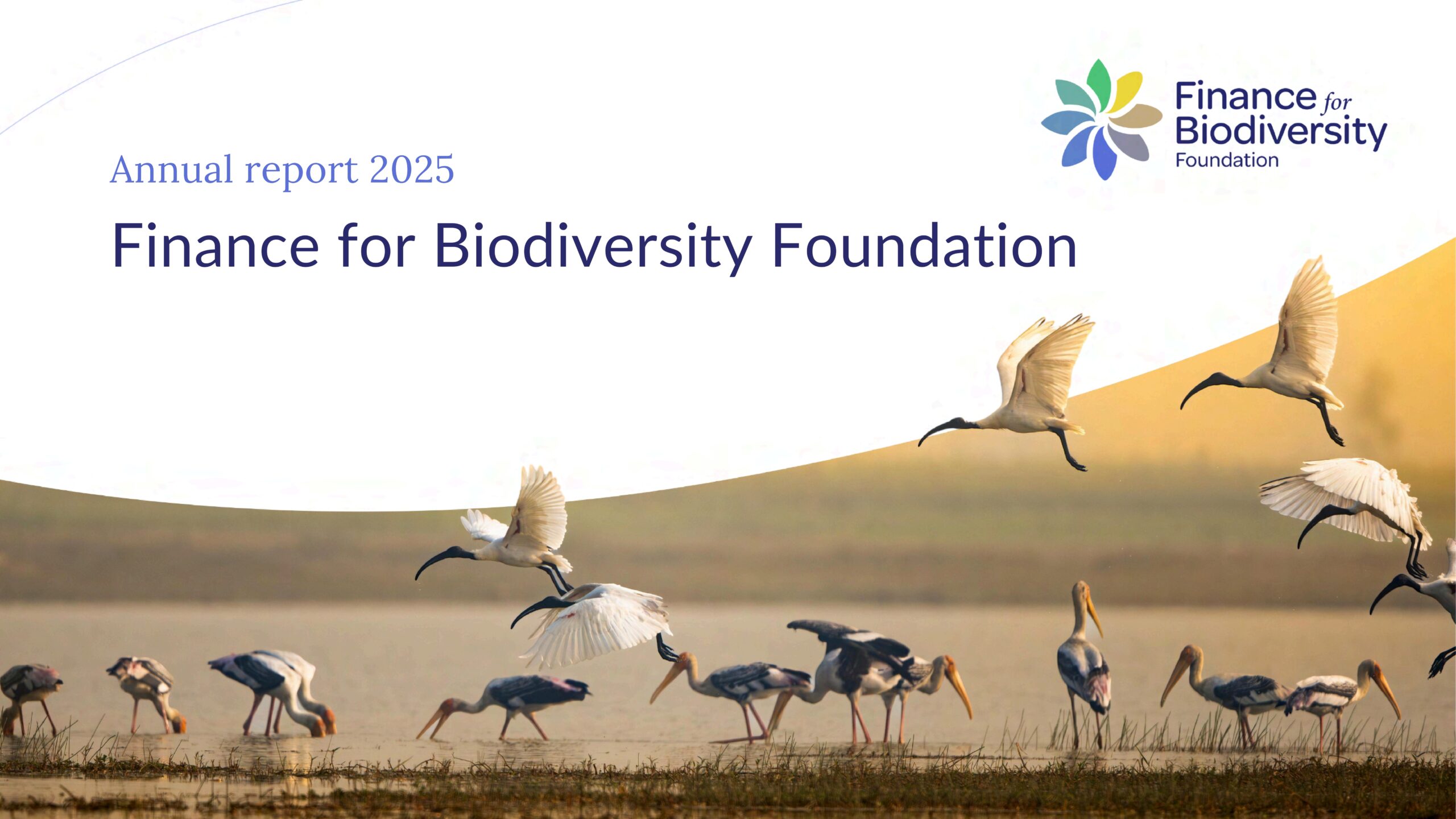
Finance for biodiversity foundation annual report series
This annual report series tracks the progress of global financial institutions in addressing nature loss through the Finance for Biodiversity Pledge. It provides benchmarks, technical guidance, and policy analysis to help professionals integrate biodiversity into investment strategies and align with international frameworks like the Kunming-Montreal Global Biodiversity Framework.
Please login or join for free to read more.

OVERVIEW
Overview of the series
The Finance for Biodiversity Foundation Annual Report series provides a comprehensive record of the global financial sector’s efforts to address nature loss and integrate biodiversity into investment practices. Published annually by the Finance for Biodiversity (FfB) Foundation—an independent non-profit organisation established in 2021—the series documents the evolution of the Finance for Biodiversity Pledge. It tracks the growth of a signatory community that represents a significant portion of global capital, detailing strategic priorities such as raising awareness, fostering collaboration through thematic working groups, and influencing public policy to align with international biodiversity goals. The series serves as a central mechanism for reviewing progress and sharing best practices across the industry.
Key findings and progress
The latest document in the series, the 2025 edition, highlights the continued expansion of the initiative, with the signatory community now representing approximately €20 trillion in combined assets across 27 countries. During the 2025 reporting cycle, 77 financial institutions participated in a self-assessment survey conducted between April and June 2026. This assessment benchmarked performance against the five core commitments of the FfB Pledge: collaboration and knowledge sharing, engaging with companies, assessing impact, setting targets, and reporting publicly. These findings build upon the foundations established in previous publications, including the combined 2020 and 2021 report and the 2022 edition, which collectively trace the sector’s trajectory toward aligning financial flows with the Kunming-Montreal Global Biodiversity Framework.
Strategic purpose and objectives
The series is designed to mobilise the global financial sector to actively work towards halting and reversing nature loss by 2030, with the ultimate aim of living in harmony with nature by 2050. It provides a structured framework for financial institutions to integrate biodiversity considerations into their core strategies, financing activities, and investment decisions. By offering a platform for collective action and peer learning, the reports assist organisations in managing nature-related risks and identifying opportunities for long-term value creation. The series also aims to create an enabling policy environment by providing targeted advocacy and technical guidance that supports the transition to a nature-positive global economy.
Methodology and assessment frameworks
The assessment methodology employed throughout the series relies on two primary data-gathering processes: the FfB Impact Survey and the Internal Members Progress Report (IMPR). A central component of this methodology is the Sovereign Debt Nature Assessment Model, which is structured around three interconnected pillars: the State of Natural Capital, Socio-economic Activities, and Governance Response. This model evaluates 42 distinct characteristics supported by publicly available indicators and datasets to assess nature-related risks and opportunities in sovereign finance. Additionally, the foundation operates seven thematic working groups that co-develop guidance and share best practices, ensuring that the reporting remains grounded in practical application and evolving scientific understanding.
Applications for finance professionals
Finance professionals can utilise this series to benchmark their institution’s progress against sector leaders and peer groups across various asset classes, including banking, asset management, and insurance. The reports provide access to practical tools such as the Biodiversity Measurement Approaches Guide and the FfB Biodiversity Data Catalogue, which contains nearly 2,000 nature-related data points from over 25 providers. Sector-specific guidance is also available, including initiatives like FABRIC for the textiles and apparel sector and the Sovereign Debt Nature Assessment Model for fixed-income investors. Furthermore, the series monitors critical policy developments and regulatory trends, such as the EU Commission’s Roadmap towards Nature Credits and EFRAG consultations on sustainability reporting standards, helping professionals navigate emerging requirements for nature-related financial disclosures.
LINKS & ATTACHMENTS
-
Go to source

-
3997 - 2026 - Finance for biodiversity foundation annual report 2025
-
3997 - 2025 - Finance for biodiversity foundation annual report 2024
-
3997 - 2024 - Finance for biodiversity foundation annual report 2023
-
3997 - 2023 - Finance for biodiversity foundation annual report 2022
-
3997 - 2022 - Finance for biodiversity foundation annual report 2020 and 2021
-
2022 - Finance for Biodiversity Foundation Annual report 2022
-
2022 - Finance for Biodiversity Foundation Annual report - 2020 and 2021