

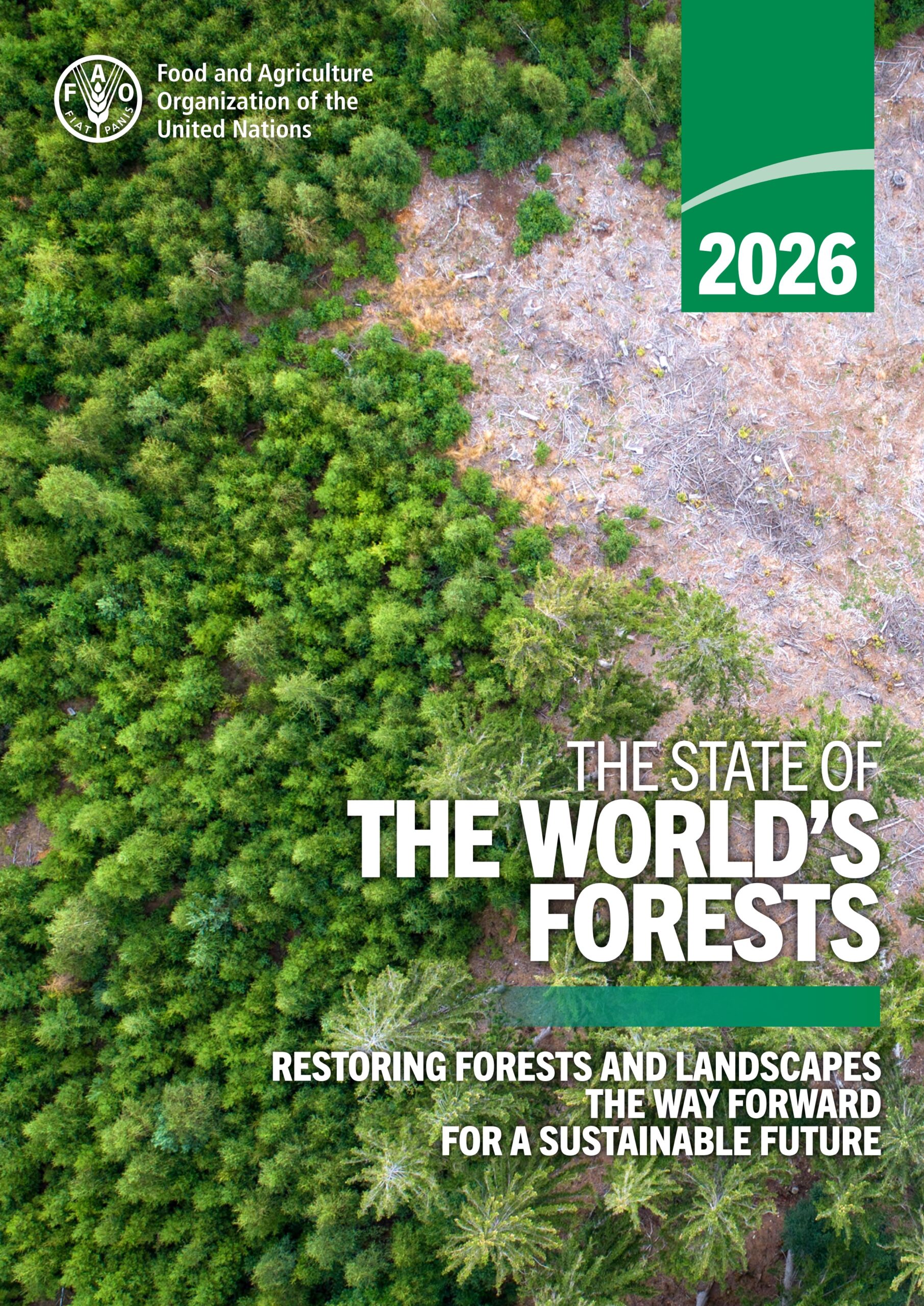
The state of the world’s forests series
The State of the World’s Forests is a biennial series by the FAO providing comprehensive data on global forest trends. It explores the economic importance of restoration, offering finance professionals insights into risk-return profiles, blended finance, and carbon markets to address the global restoration funding gap.
Please login or join for free to read more.

OVERVIEW
Overview
The State of the World’s Forests (SOFO) is a flagship benchmark series produced biennially by the Food and Agriculture Organization of the United Nations (FAO). This series provides a comprehensive analysis of the condition of global forests, tracking ecological trends, policy developments, and socioeconomic impacts across 236 countries and areas. By synthesising data from multiple international frameworks, the series serves as a primary reference for the status of forest resources and their role in sustainable development. The library collection includes the 2026, 2024, 2022, 2020, and 2018 editions, documenting the evolving global approach to forest management and conservation over time.
Key findings from the latest research
The latest research in the series focuses on forest and landscape restoration (FLR) within the context of the 2020–2030 decade. It highlights that restoration efforts can generate significant economic returns, potentially reaching USD 30 for every dollar invested. However, the series identifies a critical funding gap, noting that annual finance for restoration must quadruple from current levels to meet 2030 international targets. These findings are supported by 18 detailed case studies illustrating implementation across diverse biomes, alongside an assessment of approximately 50 forest-related variables. The analysis aligns its findings with the United Nations Decade on Ecosystem Restoration and the Kunming–Montreal Global Biodiversity Framework to address the triple planetary crises of climate change, biodiversity loss, and land degradation.
Purpose
The series exists to guide policymakers, practitioners, and investors in scaling up high-quality restoration and conservation efforts. It is designed to inform decisions regarding national development strategies, land-use planning, and financial resource allocation. By highlighting the cost-effectiveness of forest interventions and the significant risks associated with inaction, the documents aim to bridge the gap between political ambition and on-the-ground implementation. The series serves as a strategic resource for advancing agrifood systems transformation and achieving the “four betters”: better production, better nutrition, a better environment, and a better life, ensuring that global development leaves no one behind.
Methodology
The analysis follows a comparative and interpretive approach, synthesising quantitative data, policy analysis, and case-based evidence. Core evidence is sourced from the FAO Global Forest Resources Assessment (FRA), which assesses approximately 50 forest-related variables. This is supplemented by national reporting to the United Nations Convention to Combat Desertification (UNCCD), the Convention on Biological Diversity (CBD), and the United Nations Framework Convention on Climate Change (UNFCCC). The methodology examines progress through four interlinked pathways: people (inclusive governance), land (spatial planning), finance and business (financial mechanisms), and policy coherence and law. The reports utilise tools such as the Nationally Determined Contribution Expert Tool (NEXT) and the Environmental eXternalities ACcounting Tool (EX-ACT) to estimate carbon mitigation potentials.
Use for finance professionals
Finance professionals can use this series to evaluate the financial feasibility and risk-return profiles of forest and landscape restoration investments. The research provides detailed insights into innovative financial mechanisms required to mobilise capital at scale. Key areas of focus for the financial sector include:
- Blended finance models that combine public, private, and philanthropic capital to de-risk early-stage ventures.
- Environmental markets, such as voluntary carbon markets and emerging biodiversity credit infrastructures.
- Insurance-linked finance products designed to protect physical restoration work from environmental hazards like fire or drought.
- “Insetting” strategies for corporate value chain management to enhance supply chain resilience.
Professionals can utilise the provided cost ranges and benefit categories to develop bankable business models and align investments with sustainability-linked targets and emerging regulatory reporting requirements. The series offers a robust evidence base for understanding how forest-based assets contribute to climate mitigation and long-term portfolio resilience.
LINKS & ATTACHMENTS
-
Go to source

-
Download the report (PDF)
-
2018 - The State of the World’s Forests 2018 - Forest pathways to sustainable development
-
2026 - The state of the world’s forests 2026: restoring forests and landscapes – the way forward for a sustainable future
-
2024 - THE STATE OF THE WORLDS FORESTS
-
2022 - Uploaded: cb9360en.pdf
-
2020 - The State of the World's Forests 2020: Forests, Biodiversity and People – In Brief



