

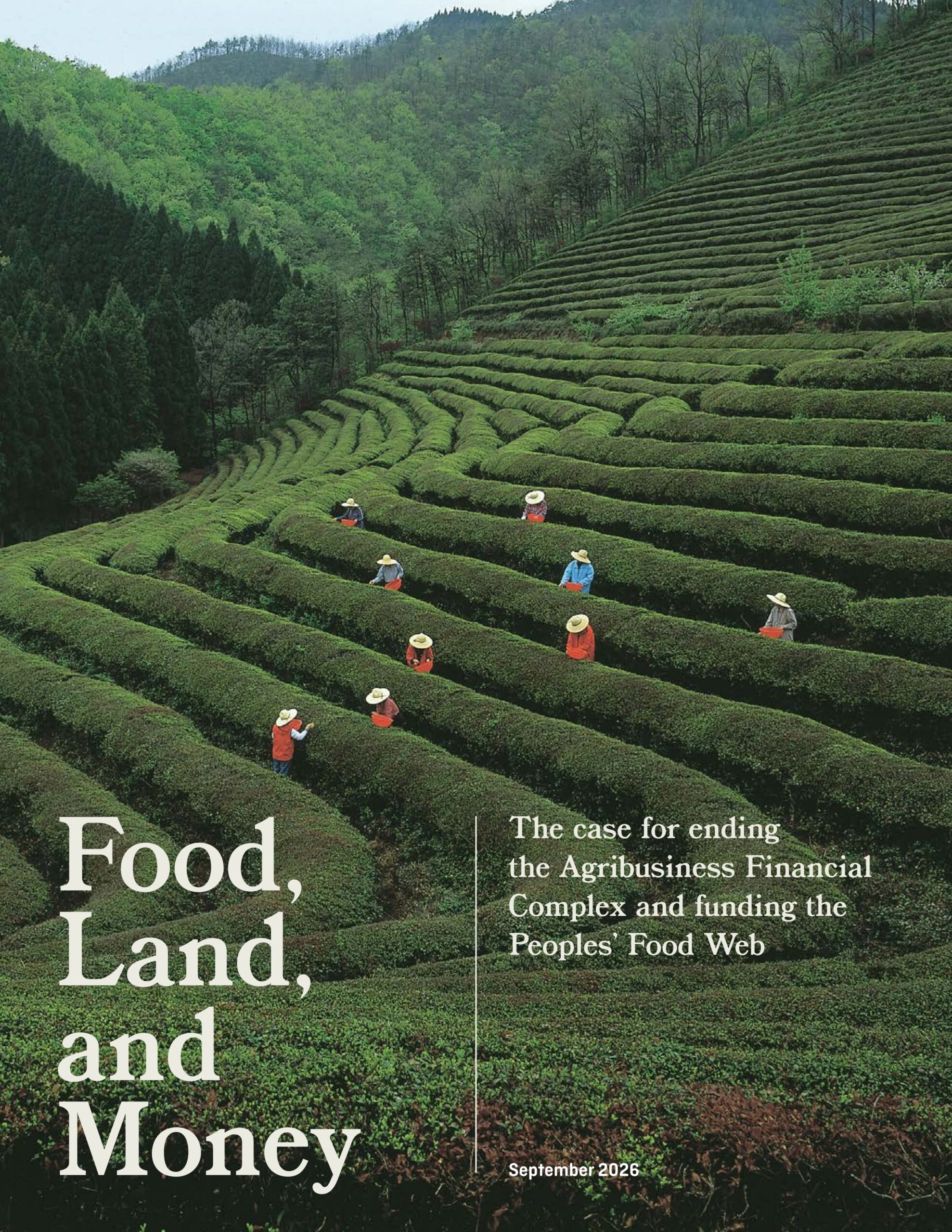
Food, land, and money: The case for ending the Agribusiness Financial Complex and funding the Peoples’ Food Web
This report examines the ‘Agribusiness Financial Complex’, where global finance and industrial agribusiness prioritise shareholder profit over food security. It analyses the top 100 agrifood companies, highlights the environmental and social harms of financialisation, and advocates for a transition to a decentralised ‘Peoples’ Food Web’ through agroecology.
Please login or join for free to read more.

OVERVIEW
Executive summary
The global food system is dominated by the “Agribusiness Financial Complex”, an entangled network of industrial agribusiness corporations and global financial institutions that prioritises shareholder value over human nutrition. In 2022, the 100 largest agrifood companies generated US$4.5 trillion in revenue, with the top 10 alone accounting for 28% of that total. Financial concentration is extreme, as just three asset managers—Vanguard, BlackRock, and State Street—own 22% of the shares in the Agrifood 100. During 2021–2022, 20 grain, fertiliser, meat, and dairy companies paid US$53.5 billion to shareholders, a figure exceeding the UN’s estimated US$51.5 billion required to feed the world’s 230 million most vulnerable people.
Introduction
In the aftermath of the COVID-19 pandemic, global food prices reached record highs while nearly a billion people went hungry. Despite rhetoric regarding efficiency, the industrial food and agriculture system uses up to 70% of global agricultural land and resources while feeding less than 30% of the world’s population. The report defines the “Agribusiness Financial Complex” as the fusion of industrial agribusiness and global finance, which extracts wealth from land, labour, and public resources to funnel it to distant corporations. Conversely, the “Peoples’ Food Web” represents decentralised, biodiverse systems that already sustain the majority of the world’s population, particularly in the Global South.
Part I: Seeing the fragile and failing industrial food system for what it is
The dominant industrial food system is described as dangerously fragile and failing morally, socially, and ecologically. It has contributed to crossing seven of the nine scientifically established planetary boundaries, including climate change and biosphere integrity. Industrial agriculture is the leading cause of tropical deforestation and is responsible for approximately one-third of global greenhouse gas emissions. The reliance on petrochemical inputs makes the system vulnerable to trade shocks, such as the blockage of the Strait of Hormuz in March 2026, which disrupted one-third of the global seaborne fertiliser trade and inflated prices across the food chain.
Three fundamental flaws in the system
The report identifies three structural flaws: the system is fundamentally extractive and exploitative, it creates systemic risk and fragility, and it destroys democracy through state capture. Hidden costs of the food system, including pollution and disease, are estimated at US$12 trillion annually. The system relies on constant infusions of public money, with governments transferring more than US$850 billion per year to industrial agriculture. In the US, 70% of these subsidies benefit just 10% of farms. This “state capture” allows corporate lobbying to lock in policies that favour chemical-intensive commodity farming over resilient alternatives.
Part II: Corporate giants in a failed food system
The “Agrifood 100” analysis reveals that food retailers are the dominant actors by scale, with Walmart, Schwarz Group, Kroger, and Costco among the top five. Commodity traders, including the “ABCD” firms (Archer Daniels Midland, Bunge, Cargill, and Louis Dreyfus), represent the next largest group. These firms exert immense sway over global markets and frequently generate substantial revenue from financial speculation rather than physical movement of goods. The report highlights “horizontal shareholding”, where the same institutional investors hold major stakes in competing firms within a sector, as a primary anticompetitive threat that increases consumer prices.
Part III: Strengthening the peoples’ food web
To secure a liveable future, the report argues for shifting financial flows from extractive models to regenerative approaches. Currently, only 0.8% of agrifood climate finance reaches small-scale farmers. Transformation requires four interrelated strategic approaches: discrediting the legitimacy of the Agribusiness Financial Complex, defunding harmful industrial activities, definancialising food and land systems to treat them as public goods, and repairing systems through agroecology and land reform. Reclaiming public resources for the public interest is essential to address climate change and biodiversity loss.
Resourcing food sovereignty and agroecology
The perceived “finance gap” for food system transformation is described as a myth. Governments currently spend nearly twice as much on environmentally harmful subsidies as the estimated US$500 billion-per-year required to transform global agrifood systems. New finance models are emerging, such as community land trusts, Indigenous sovereignty funds, and food cooperatives, which prioritise justice and care. The report calls for the radical reform of international financial institutions to support public food and land governance and the adoption of development indicators based on human rights and well-being rather than growth imperatives.




