

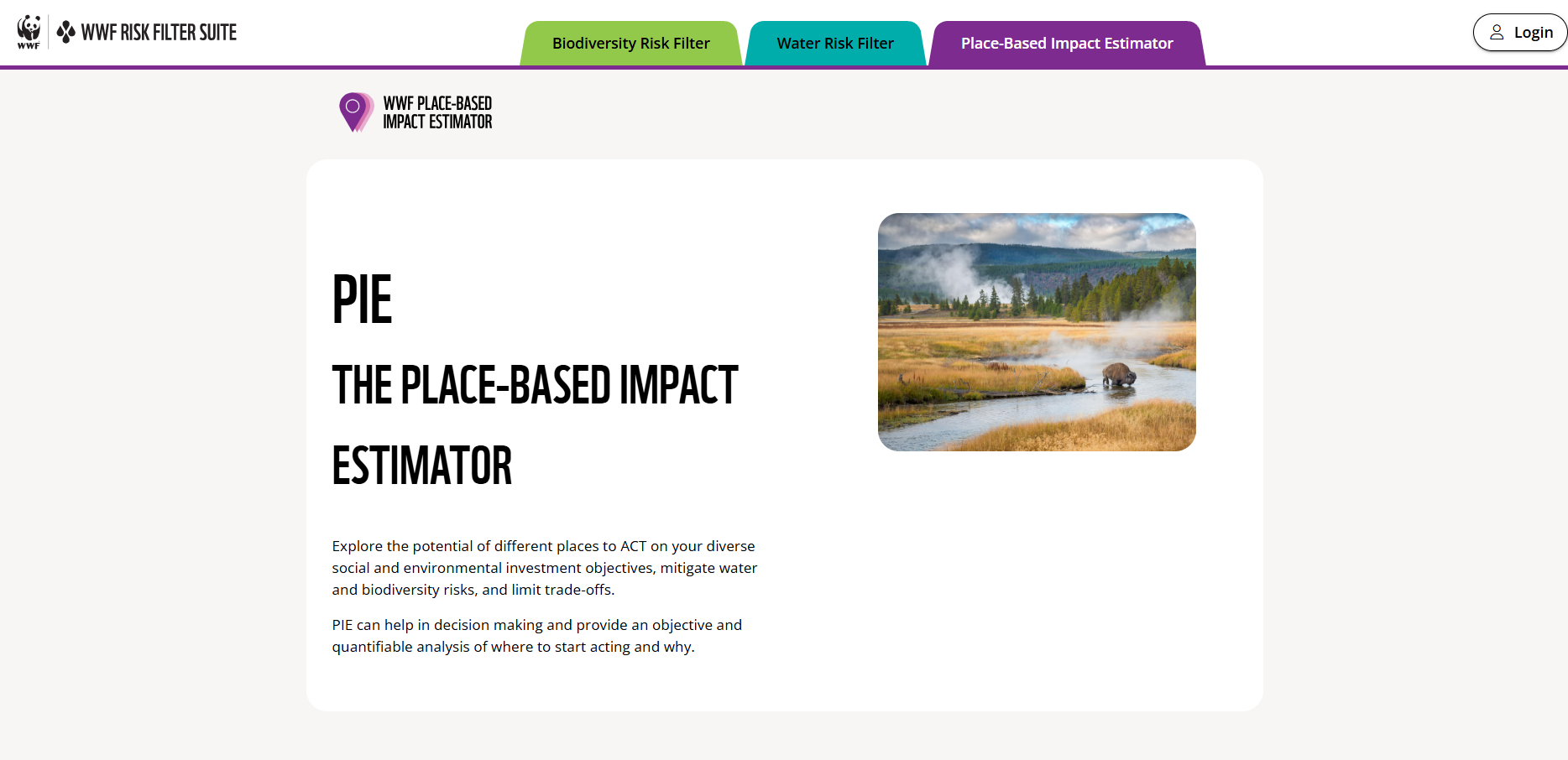
Place-based biodiversity investment tool
The Place-based Impact Estimator (PIE) is a geospatial tool by WWF that helps organisations identify optimal locations for nature-based investments. It balances objectives like carbon storage and biodiversity to help finance professionals select high-impact projects while managing environmental trade-offs.
Please login or join for free to read more.

OVERVIEW
The Place-based Impact Estimator (PIE) is a free geospatial tool designed to help organisations identify optimal locations for environmental and social investment. By balancing multiple objectives such as carbon storage, species preservation, and water security, it allows users to screen for areas where actions—such as restoration or improved land management—can deliver the highest impact. The tool is particularly relevant for finance professionals seeking to align investment portfolios with nature-positive outcomes and climate goals while minimising negative trade-offs.
Organisation behind the tool
The tool was developed and is maintained by WWF (World Wide Fund for Nature), specifically involving WWF Germany. It is part of the broader WWF Risk Filter Suite, which includes the Water Risk Filter and Biodiversity Risk Filter.
What the tool does
PIE provides a range of geospatial analysis features, including:
- A Portfolio Manager to track and build assessments across diverse geographies.
- The Explore module, which allows users to visualise spatial datasets related to ecology, land tenure, and social factors.
- The Optimize module, which uses an optimization engine to suggest specific locations that balance conflicting goals, such as increasing carbon sequestration without displacing agriculture.
- Country Profiles and data galleries that provide context on local ecology and capacity for impact.
Target audience
The primary audience includes companies, project managers, and donors. It is specifically designed for non-experts without geographic information systems (GIS) training, though GIS professionals can download data for more advanced analysis.
Relevance to finance professionals
Finance professionals can utilise PIE to enhance their decision-making in several areas:
- Risk assessment – Identifying locations where investments can mitigate physical water and biodiversity risks.
- ESG analysis – Providing quantifiable metrics and maps for reporting on biodiversity and social impact objectives.
- Investment context – Evaluating candidate areas for nature-based solutions or impact-driven investments to ensure capital is directed where it is most material.
- Trade-off management – Analysing potential negative impacts of climate-focused investments (e.g. carbon) on other environmental factors like freshwater or local livelihoods.





