

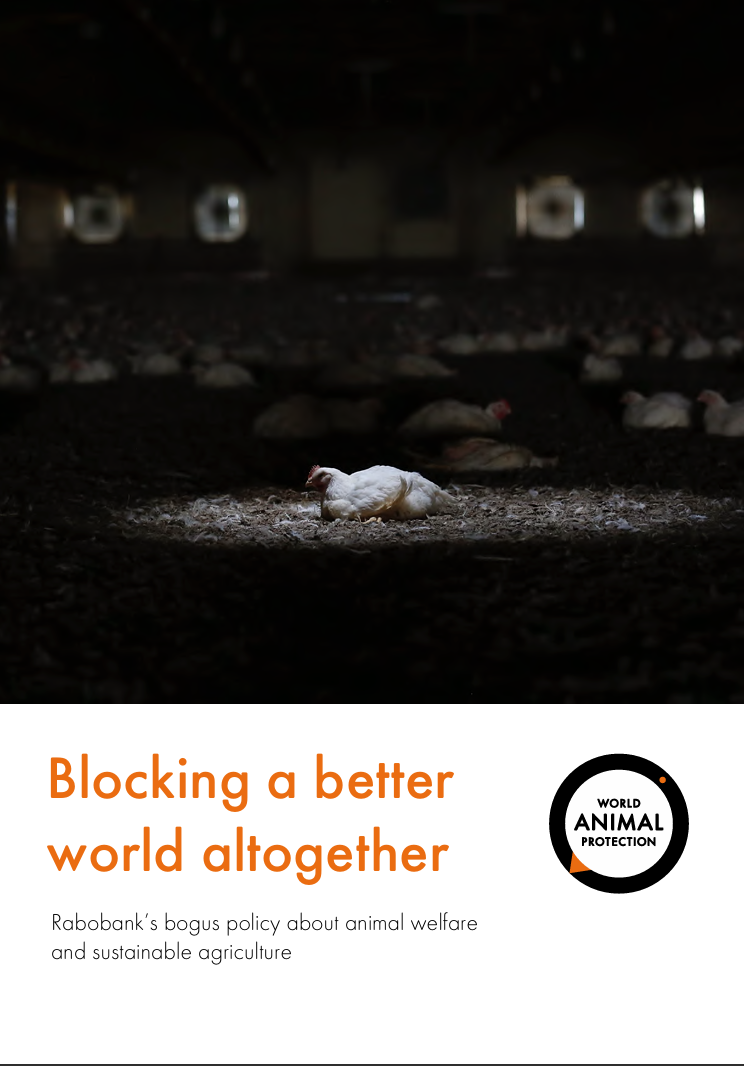
Blocking a better world altogether: Rabobank’s bogus policy about animal welfare and sustainable agriculture
World Animal Protection argues Rabobank’s sustainability policies fail to match its financing practices, alleging continued support for companies linked to animal cruelty, deforestation and high emissions. The report urges stricter lending conditions, stronger monitoring and reduced investment in industrial livestock expansion to align with climate and animal welfare goals.
Please login or join for free to read more.

OVERVIEW
About this report
The report assesses Rabobank’s sustainability policies, financing activities and exposure to industrial animal agriculture. It draws on Rabobank disclosures, engagement responses, financial research by Profundo and analysis of 52 major animal protein companies linked to animal welfare, deforestation and climate risks.
Introduction: No future for factory farming, or no future
The report argues that industrial animal agriculture contributes materially to climate change, biodiversity loss and environmental degradation. It highlights that agriculture and food systems account for almost one-third of global greenhouse gas emissions and states that Rabobank’s large role in global agri-food financing creates heightened responsibility for managing these risks.
Chapter 1: The bank of the perpetrators
Profundo estimates Dutch financial institutions provided at least US$53.8 billion in loans and underwriting services to selected companies between January 2016 and March 2024. Rabobank accounted for US$25.4 billion across 52 companies, making it the largest financier in the sample.
Major recipients included Tyson Foods (US$2.79 billion), Restaurant Brands International (US$2.58 billion), Viterra (US$1.92 billion), Bayer (US$1.65 billion) and JBS (US$1.35 billion). The report argues Rabobank finances companies associated with high greenhouse gas emissions, deforestation and poor animal welfare practices.
Chapter 2: Lies, damn lies, and rabobank
The report claims Rabobank overstates the effectiveness of its sustainability approach while understating risks within its lending portfolio. It argues the bank relies on broad commitments and engagement language without sufficient evidence of measurable improvements by clients.
The report specifically criticises Rabobank’s ongoing relationship with companies such as JBS, alleging continued financing despite awareness of practices including high stocking densities, battery cages and gestation crates. It also argues Rabobank presents financing controversial companies as preferable to disengagement, which the authors describe as a false dilemma.
Chapter 3: Loopholes and excuses dressed as policy
The report states Rabobank’s policies rely heavily on encouraging improved practices rather than enforcing binding standards. It references the FARMS Initiative minimum welfare standards, including reduced stocking densities, improved air quality controls, no cages or multi-tiered systems and annual third-party auditing.
Research cited from Wageningen University suggests implementation costs would be moderate while welfare improvements would be significant. The report argues Rabobank fails to verify whether financed companies meet these standards and lacks adequate monitoring, reporting and enforcement mechanisms.
Chapter 4: The big shift
The report argues Rabobank must align financing decisions with long-term climate and food system transition goals. It warns that financing livestock expansion may create stranded assets because agricultural investment cycles can extend beyond 20 years.
Recommended actions include ending financing for expansion of industrial factory farms, applying sustainability requirements across entire corporate groups and mapping absolute Scope 3 emissions across lending portfolios. The report also calls for financing decisions to align with pathways consistent with limiting warming to 1.5°C.
Chapter 5: Conclusions and expectations
The report concludes that a significant gap exists between Rabobank’s sustainability commitments and its financing practices. It alleges continued exposure to companies linked to animal cruelty, deforestation and disproportionate emissions.
Recommendations include embedding sustainability clauses into loan agreements, strengthening monitoring and reporting processes, expanding sustainability staffing and ending relationships where clients fail to improve. The report also calls for stronger lobbying support for animal welfare and anti-deforestation regulation.




