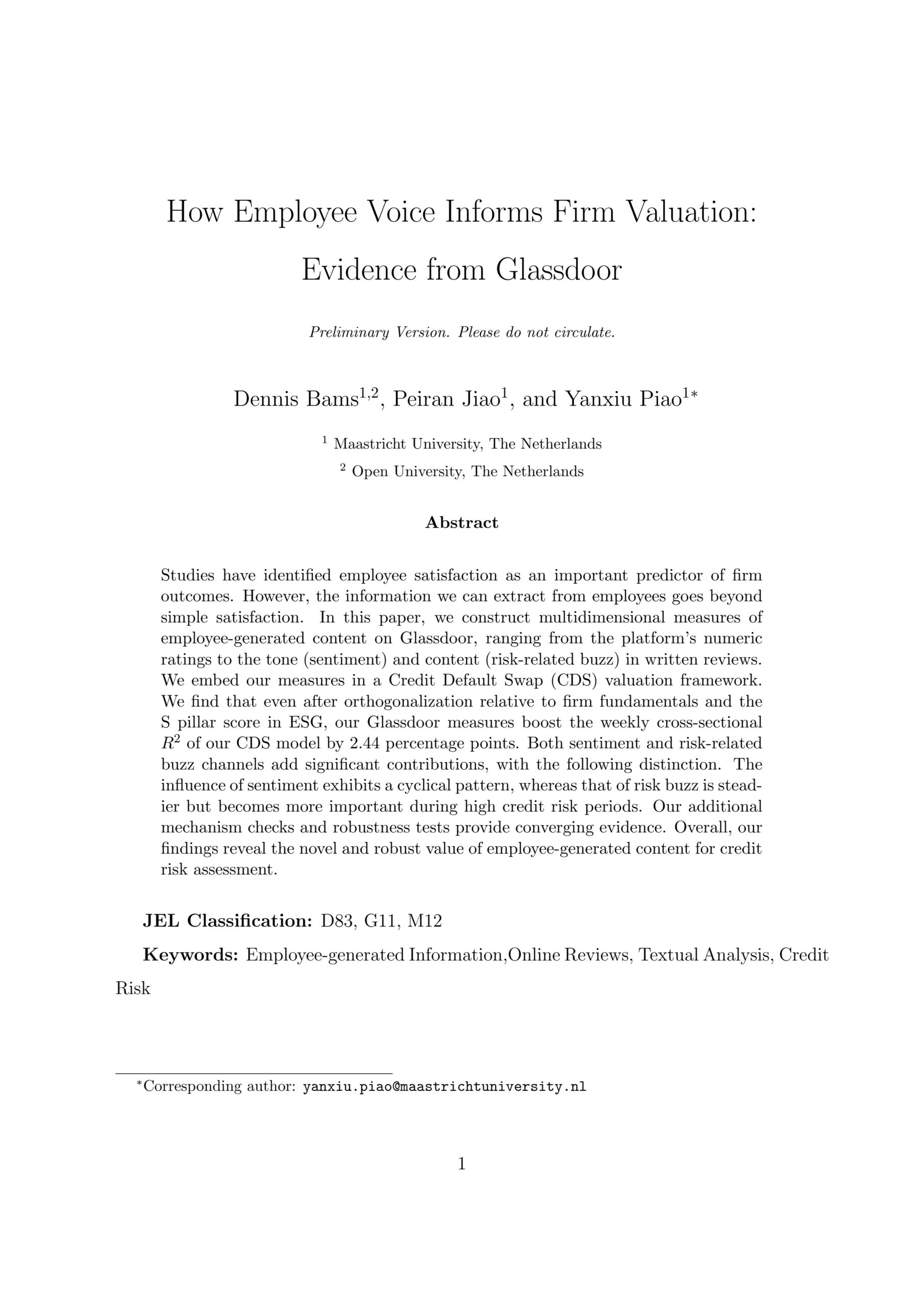
How employee voice informs firm valuation: Evidence from Glassdoor
This research examines how employee reviews on Glassdoor inform firm valuation and credit risk. Using a Bayesian framework, the study demonstrates that employee sentiment and risk-related narratives significantly improve the accuracy of credit default swap spread models beyond traditional financial fundamentals and ESG metrics, particularly during high-risk periods.
Please login or join for free to read more.

OVERVIEW
Introduction
Extant literature in finance acknowledges that employees are vital to firm value, yet much of the evidence relies on broad aggregates like payroll expenses or Social pillar scores in ESG frameworks. These measures often mask granular and dynamic information. This research demonstrates that Glassdoor, an independent, bottom-up information source, contains non-redundant signals overlooked in conventional disclosures. The study develops multidimensional measures based on numeric ratings and unstructured written reviews, embedding them in a credit-risk assessment model focused on Credit Default Swap (CDS) spreads. The research isolates two primary channels: the sentiment (behavioural) channel, reflecting how employees feel about their workplace, and the risk-related buzz (informational) channel, capturing substantive risk factors in narratives.
Data collection and sample construction
The researchers collected data from multiple sources to form a sample of 417 publicly traded U.S. firms covering the period from August 2012 to August 2023. The dataset includes CDS data from S&P Global (formerly Markit), financial statements from Compustat, stock option implied volatilities from Ivy DB OptionMetrics, and stock market data from the Centre for Research in Security Prices (CRSP). These were matched with MSCI ESG Ratings and employee reviews from Glassdoor. To avoid look-ahead bias, financial statement information was matched with market variables using a 45-day rule. The Glassdoor data includes structured numeric ratings across dimensions such as work-life balance and senior management, as well as unstructured text from ‘pros’, ‘cons’, and ‘advice to management’ fields.
Methodology
The study employs a Bayesian shrinkage framework to model CDS spreads in a layered structure. The process begins with Merton-model factors (MCDS), then incorporates financial fundamentals (FCDS), followed by the ESG Social pillar (SCDS), and finally Glassdoor-based measures (GCDS). At each stage, new variables are orthogonalised relative to preceding layers to ensure they contribute distinct information. Sentiment is measured using a BERT-based classifier, which computes an indicator as the difference between probabilities of positive and negative language. The risk-related buzz channel is estimated using multinomial inverse regression (MNIR) to isolate phrases predictive of future firm risks, such as operational rigidity or resource constraints. An instrumental variable (IV) approach addresses endogeneity by using exogenous mood shocks, such as the number of blockbuster movie releases and global aviation fatalities.
Results
The inclusion of Glassdoor numeric ratings raises the model’s explanatory power by 1.44 percentage points in terms of cross-sectional R-squared relative to a baseline including financial fundamentals and the Social pillar. Adding written-review-based measures (sentiment and risk-related buzz) further increases the R-squared by 1.00 percentage point, achieving a total boost of 2.44 percentage points over the S-adjusted model. On average, a 1-standard-deviation (SD) change in Sentiment is associated with a 0.002-SD change in ln(CDS), while a 1-SD change in Risk-Related Buzz is associated with a 0.014-SD change in ln(CDS).
The importance of these channels varies over time; sentiment is more cyclical, while risk-related buzz is more persistent and becomes more critical during high credit risk periods. Heterogeneity analyses show that a 1-SD increase in Sentiment narrows CDS spreads by approximately 15 basis points (bps) in low-labour-intensity firms and 11 bps in high-labour-intensity firms. In contrast, Risk-Related Buzz delivers a consistent widening of about 15 bps across both groups. Portfolio tests confirm the economic value of these findings, with the GCDS-based strategy generating an annualised mean return of 1.706% at a one-week rebalancing horizon, outperforming benchmarks.
Conclusion
The findings reveal the robust value of employee-generated content for credit risk assessment. Employee sentiment and risk-related buzz provide novel information that is not captured by traditional financial metrics or existing ESG ‘S’ scores. The researchers suggest that current Social metrics in ESG scores likely underweight forward-looking information regarding operational and compliance risks. For practitioners, combining structured ratings with written-review-based measures yields more responsive credit assessments. For policymakers, the evidence indicates a significant scope to improve existing measures by monitoring bottom-up views to better capture firm-specific soft information for risk management.