

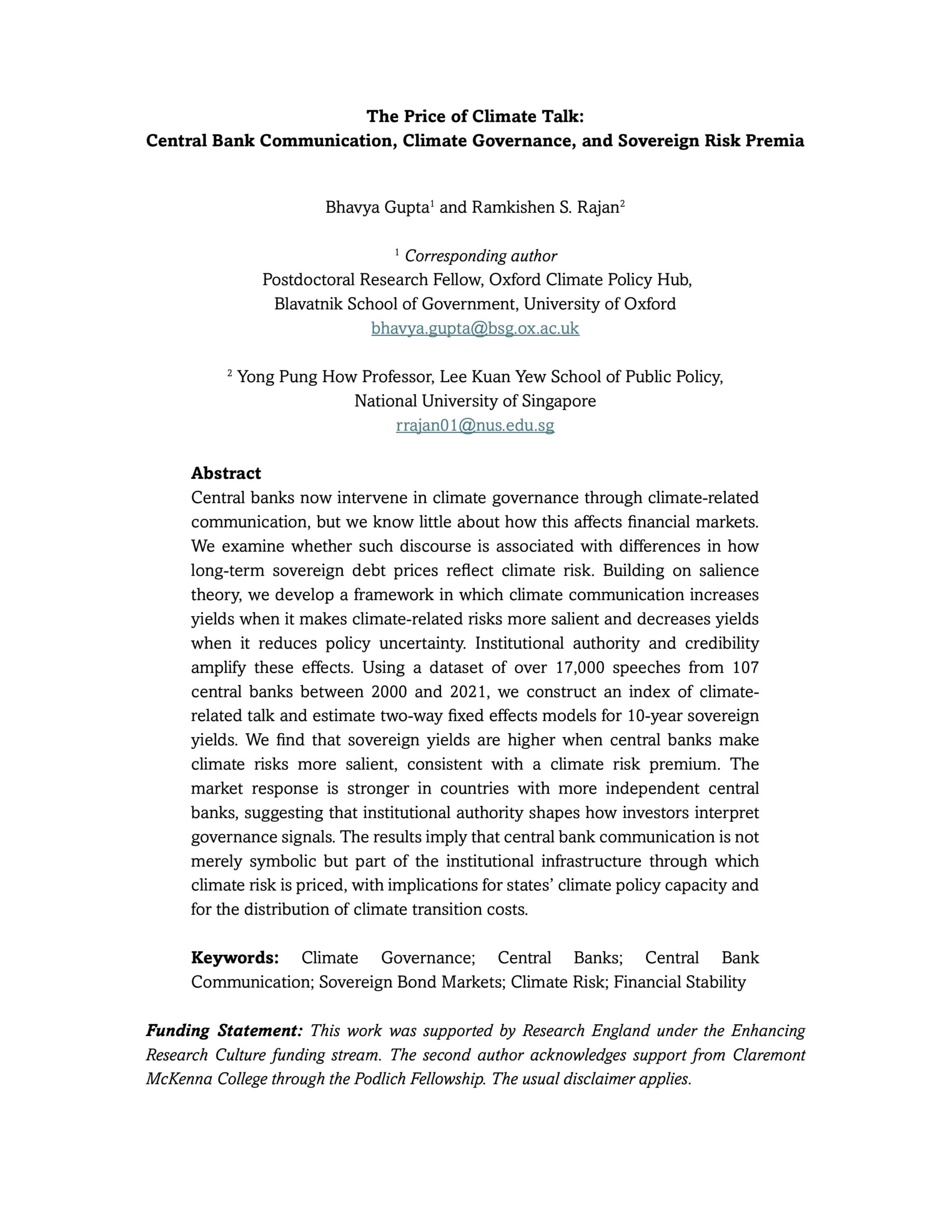
The price of climate talk: Central bank communication, climate governance, and sovereign risk premia
This research examines how central bank climate communication affects 10-year sovereign bond yields. Using a dataset of over 17,000 speeches, it finds that climate-related discourse increases yields by making risks more salient. This effect is stronger in countries with independent central banks, reflecting the role of institutional credibility.
Please login or join for free to read more.

OVERVIEW
Central bank communication and climate change
Central bank communication has shifted from the deliberate opacity of the 1980s and 1990s towards explicit forward guidance and transparency. Recently, central banks have begun addressing risks at the edge of their formal mandates, specifically climate change. Since the Paris Agreement, climate change has been increasingly framed as a threat to macro-financial stability. Central banks now routinely highlight both transition and physical risks, marking a sharp break from the pre-Paris era. This discourse functions as a governance instrument, leveraging institutional authority and credibility to influence how investors interpret climate-related uncertainty and price risk in sovereign bond markets.
Theoretical framework
The research develops a behavioural model adapted from salience theory to formalise how climate talk affects bond pricing through two competing mechanisms. The salience mechanism suggests that increased communication raises the subjective weight investors assign to climate exposures, thereby increasing yields. Conversely, the information mechanism posits that communication can reduce perceived uncertainty by conveying meaningful information about policy directions and regulatory frameworks, which would decrease yields. The model assumes that institutional credibility amplifies these effects, with more independent central banks commanding higher market responsiveness. This framework yields two testable hypotheses: that climate communication is associated with higher yields when the salience mechanism dominates, and that this association is stronger where central banks have higher institutional authority.
Empirical model
The study examines the association between central bank climate discourse and sovereign bond yields using a two-way fixed effects model. This approach controls for time-invariant unobservables through country fixed effects and factors varying over time, such as the global financial crisis or the COP-21 Paris Agreement, through year fixed effects. The model includes a comprehensive set of determinants, such as real GDP, inflation, government debt as a share of GDP, primary balance, and institutional quality indicators. The central bank climate communication index is the primary independent variable, tested against 10-year sovereign bond yields.
Data and variable construction
The key independent variable is a text-based measure of climate talk generated from over 17,000 speeches delivered by central bankers across 107 countries between 2000 and 2021. Natural language processing (NLP) techniques were used to identify “green words” related to climate change and the net-zero transition. Two indices were constructed: Greenindex1, which counts the frequency of “climate”, “environment”, and “green”, and Greenindex2, which excludes “environment” to reduce noise. The dependent variable is the yield on 10-year sovereign bonds for 41 countries (reduced to 37 in the final empirical analysis due to data availability), sourced from Global Financial Data.
Empirical findings
The baseline results indicate that central bank climate discourse is associated with higher 10-year sovereign bond yields, suggesting the salience channel dominates the information channel. Specifically, an increase of one standard deviation in the “greenness” of speeches is associated with an average increase of 0.15 standard deviations in yields, roughly equivalent to 45 basis points. This relationship remains robust even after accounting for the physical incidence of climate disasters using EM-DAT data, where a one-standard-deviation increase in talk corresponds to approximately 0.46 percentage points. Furthermore, the association is moderated by central bank independence; in countries with high independence, increased climate talk is strongly associated with higher yields, whereas the relationship does not hold in countries where independence is below the median.
Conclusions and policy implications
The results position central bank discourse not as neutral information provision but as an active form of climate governance with material economic consequences. Institutional authority and credibility function as power resources that structure how climate uncertainty becomes economically meaningful. However, this creates potential distributional tensions: countries that speak more about climate risk may face higher financing costs for climate transitions. This “double penalty” suggests that countries with lower institutional credibility may lack governance authority while potentially facing higher costs when attempting to signal climate awareness. The findings underscore the need for future research to examine how these governance signals are interpreted across different asset classes, such as corporate credit spreads and equities.




