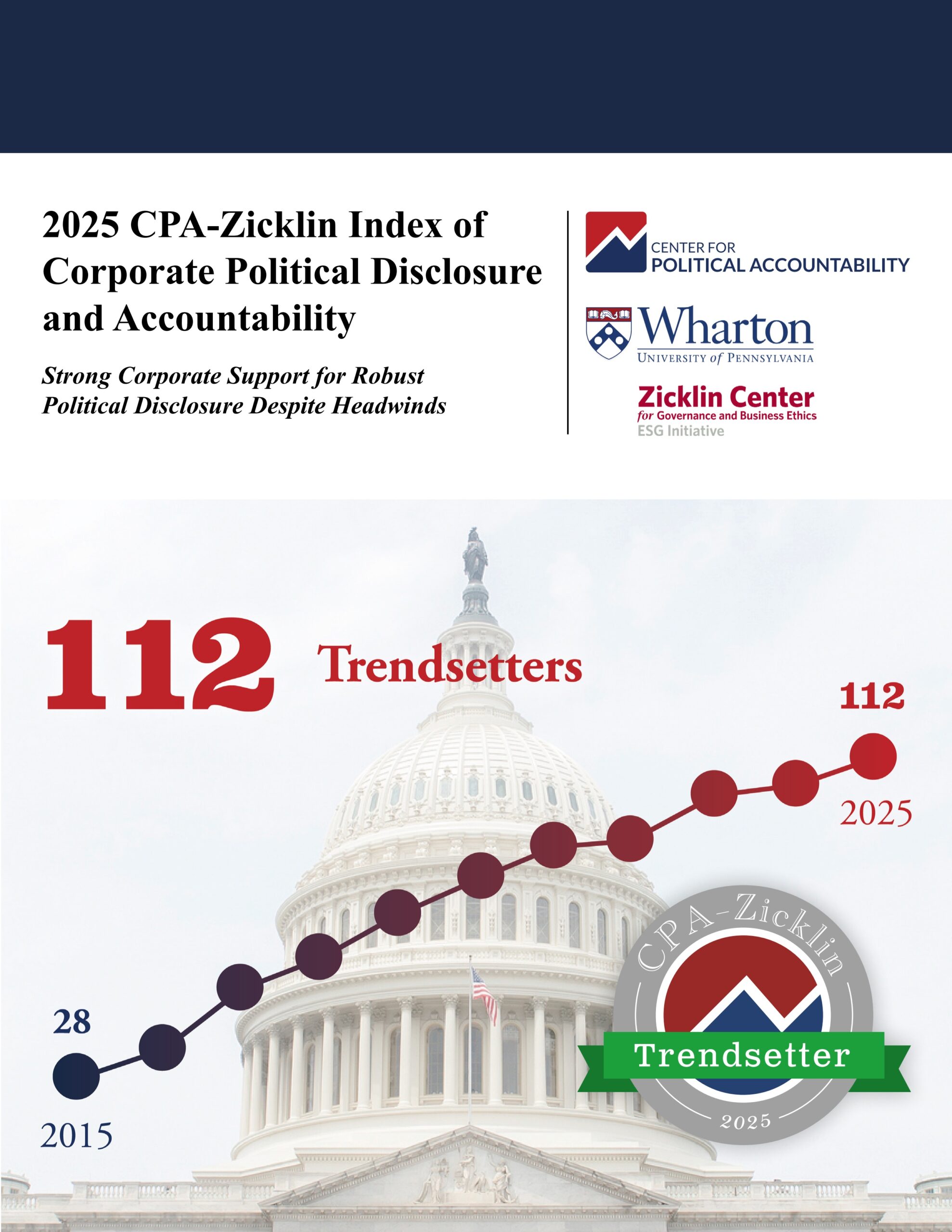
CPA-Zicklin Index of Corporate Political Disclosure and Accountability
This benchmark series evaluates corporate political disclosure and accountability practices among major US companies. It provides a structured analysis of transparency, board oversight, and spending policies for the S&P 500 and Russell 1000, enabling stakeholders to assess political risk and governance standards across different industries.
Please login or join for free to read more.

OVERVIEW
Overview
Produced by the Center for Political Accountability and the Carol and Lawrence Zicklin Center for Governance and Business Ethics at the Wharton School, this benchmark series represents a decade of data on election transparency. It tracks the progress of S&P 500 and Russell 1000 companies in disclosing their political spending and establishing robust oversight. The evaluation covers corporate treasury funds used for both direct and indirect political activities, including contributions to candidates, political committees, and third-party advocacy organisations.
Purpose
The index serves as a tool for investors to assess how companies manage the financial and reputational risks associated with political engagement. It is designed to encourage ‘private ordering’, where companies voluntarily adopt best practices to cushion themselves against the instability of the current political environment. By providing a clear framework, it enables boards of directors to make informed decisions that align political spending with corporate values and shareholder interests, ultimately promoting greater accountability and transparency in the democratic process.
Methodology
The scoring process is based entirely on publicly available information found on company websites. Analysts evaluate each company against 24 specific indicators, categorised into sections for disclosure, policy, and oversight. These indicators assess whether companies provide itemised lists of recipients, clear spending policies, and evidence of board-level review. Based on their total scores, companies are categorised into five tiers: First Tier (80-100%), Second Tier (60-79.9%), Third Tier (40-59.9%), Fourth Tier (20-39.9%), and Bottom Tier (0-19.9%). The index also identifies ‘Trendsetters’—firms scoring 90 per cent or higher.
Use for Finance Professionals
Finance professionals, particularly those focused on environmental, social, and governance (ESG) factors, can utilise the index to identify potential risks to shareholder value. The report provides granular data to help price political risk and distinguish between leaders and laggards in corporate governance. Investors can use the benchmarks to engage with management during proxy seasons or to inform voting decisions on shareholder resolutions. Furthermore, the sector-level analysis allows for performance comparisons across industries, such as Utilities, Consumer Staples, and Energy, providing a comprehensive view of how different market segments are responding to pressures for transparency. This data is essential for managing portfolios in a hyper-polarised electorate where corporate political activity is under intense public scrutiny.
LINKS & ATTACHMENTS
-
Go to all editions

-
2002 - 2025 - CPA-Zicklin index of corporate political disclosure and accountability: Strong corporate support for robust political disclosure despite headwinds
-
2002 - 2022 - CPA-Zicklin index of corporate political disclosure and accountability: Index expanded to Russell 1000; dramatic gap in disclosure and accountability between S&P 500 and smaller companies